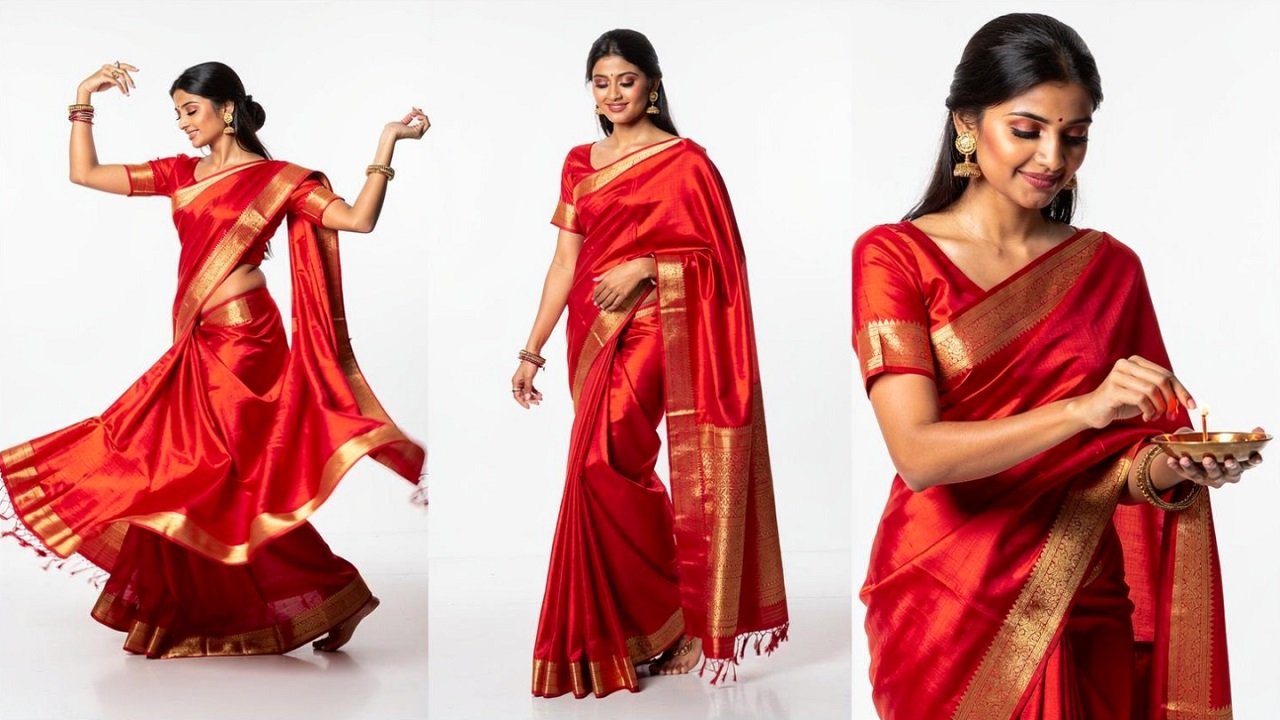
15 Best AI Prompts for Indian Girl Image in Saree: AI image generators like ChatGPT, Grok, Gemini, and Claude are getting very good at creating realistic pictures. But to get the perfect image of an Indian girl in a saree, you need the right words. The pose, lighting, background, and even the fabric of the saree matter a lot.
In this post, I will share ten easy prompts that anyone can use. These 15 Best AI Prompts for Indian Girl Image in Saree will help you create beautiful and natural-looking Indian girl saree images in different poses from dancing to sitting, walking to lighting diyas. You don’t need to be a technical person. Just copy and paste these prompts into your favorite AI tool.
Where You can use AI Prompts for Indian Girl Image?
The best part is that these prompts work for all major AI platforms. You can use them on ChatGPT’s DALL·E 3, Grok on X, Google Gemini, and even Claude if connected to an image generator. For example, one prompt asks for an Indian girl in a red Banarasi saree standing by a window with soft morning light. Another one describes a girl in a green silk saree doing a classical dance pose inside a temple corridor.
Some prompts are candid, like walking in the rain in Kolkata. Others are professional, like sitting in a rooftop café wearing a pastel saree. You will find a pose for every mood and occasion.
I have also included a vintage black-and-white prompt and a painterly style inspired by the famous artist Raja Ravi Varma. That one gives you a rich, traditional look. The kitchen scene prompt is great for a homely, natural feel. And the city bridge prompt works well if you want a modern, bold look. Each prompt tells the AI exactly what to do from the color of the saree to the lighting and even the camera style.
How to Use AI Prompts for Indian Girl Image?
To get the best results, remember a few small tips. On ChatGPT, start your prompt with “Generate image”. On Grok, keep the language clear and direct. On Gemini, add “photorealistic, high detail, no text in image” at the end. Claude may not create images directly, but you can use these 15 Best AI Prompts for Indian Girl Image in Saree to plan your image or copy them into another tool.
Always describe the pose first, then the saree, then the background and lighting. This helps the AI understand your vision clearly. With these 15 Best AI Prompts for Indian Girl Image in Saree, you can easily create stunning, realistic, and artistic saree images for personal projects, social media, or just for fun.
15 Best AI Prompts for Indian Girl Image in Saree
Red Banarasi Saree Traditional Image
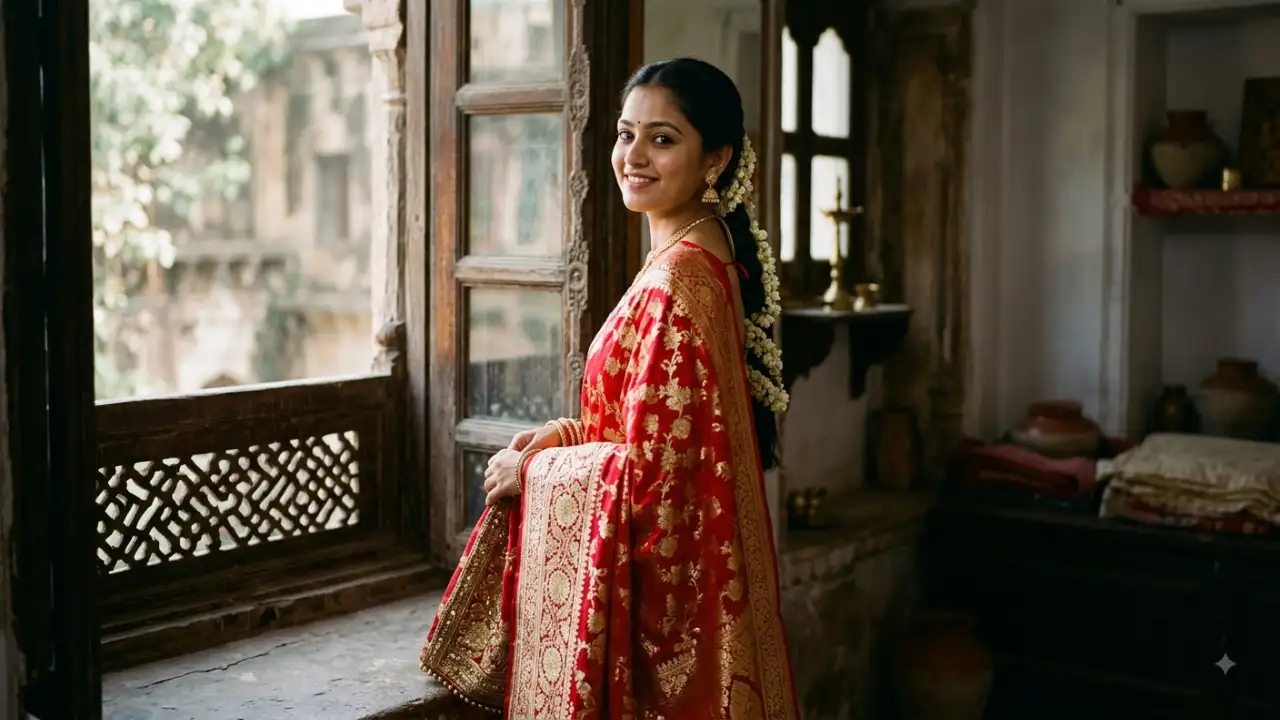
She should have naturally beautiful Indian facial features and a realistic warm Indian skin tone, with visible natural skin pores, fine facial details, expressive eyes, naturally shaped eyebrows, detailed eyelashes, realistic lips, and authentic facial proportions. Her makeup should be soft, elegant, and natural, with subtle eyeliner, lightly defined eyes, warm neutral eyeshadow, gentle blush, naturally shaped brows, and soft red or rose-colored lips. Add a small traditional red bindi to complete her Indian look. Avoid excessive makeup, artificial skin smoothing, or a plastic beauty-filter appearance.
Her long, dark black hair should be styled naturally in soft waves or a simple elegant braid, with a few delicate loose strands framing her face. Add a small arrangement of fresh white jasmine flowers near the back of her hair for a traditional touch. The hair should have realistic individual strands, natural volume, and believable texture.
She is standing sideways beside a beautiful traditional Indian wooden window, with her body positioned naturally at a slight side angle. She gently turns her head back toward the camera and looks over her shoulder with a soft, warm, and graceful smile. One hand naturally holds the edge of the saree pallu near her waist, while the other hand rests comfortably by her side. Her fingers and hands should be anatomically correct, naturally positioned, and realistically detailed. Her posture should look relaxed, elegant, feminine, and effortless rather than like an exaggerated fashion pose.
The traditional window should feature beautifully carved wooden details, subtle Indian architectural patterns, aged natural wood texture, and delicate decorative elements. Place a softly blurred traditional Indian interior behind her, with neutral-colored walls, subtle floral decorations, and a few natural elements such as green plants. Keep the background simple and uncluttered so the woman and her red Banarasi saree remain the main focus of the photograph.
Soft morning sunlight should enter naturally through the traditional window and fall gently across one side of her face, creating beautiful but realistic highlights on her skin, hair, and red silk saree. Use gentle natural shadows on the opposite side of her face to create depth. Allow the golden zari embroidery to catch subtle morning highlights without making it excessively bright or shiny. Add soft atmospheric light, realistic light falloff, and a warm peaceful morning mood.
The overall atmosphere should feel traditional, peaceful, elegant, feminine, and naturally beautiful. The photograph should look like a real professional Indian lifestyle and fashion photoshoot taken inside a heritage-style home. Maintain realistic skin texture, natural facial expression, authentic saree draping, accurate body proportions, realistic fabric movement, detailed embroidery, individual hair strands, and natural interaction between the sunlight and surrounding objects.
Capture the image using a professional full-frame DSLR or mirrorless camera with an 85mm portrait lens at approximately f/1.8 aperture. Use a medium portrait composition, approximately from the waist or mid-torso upward, with the woman's face and saree details in sharp focus while the traditional window and background gradually fall into a smooth, creamy bokeh. Use realistic perspective, natural depth of field, high dynamic range, subtle cinematic color grading, natural Indian skin tones, detailed silk texture, sharp facial features, realistic lighting, professional portrait photography, ultra HD, 8K, highly detailed, photorealistic quality.
Negative Prompt
Bharatanatyam Temple Pose
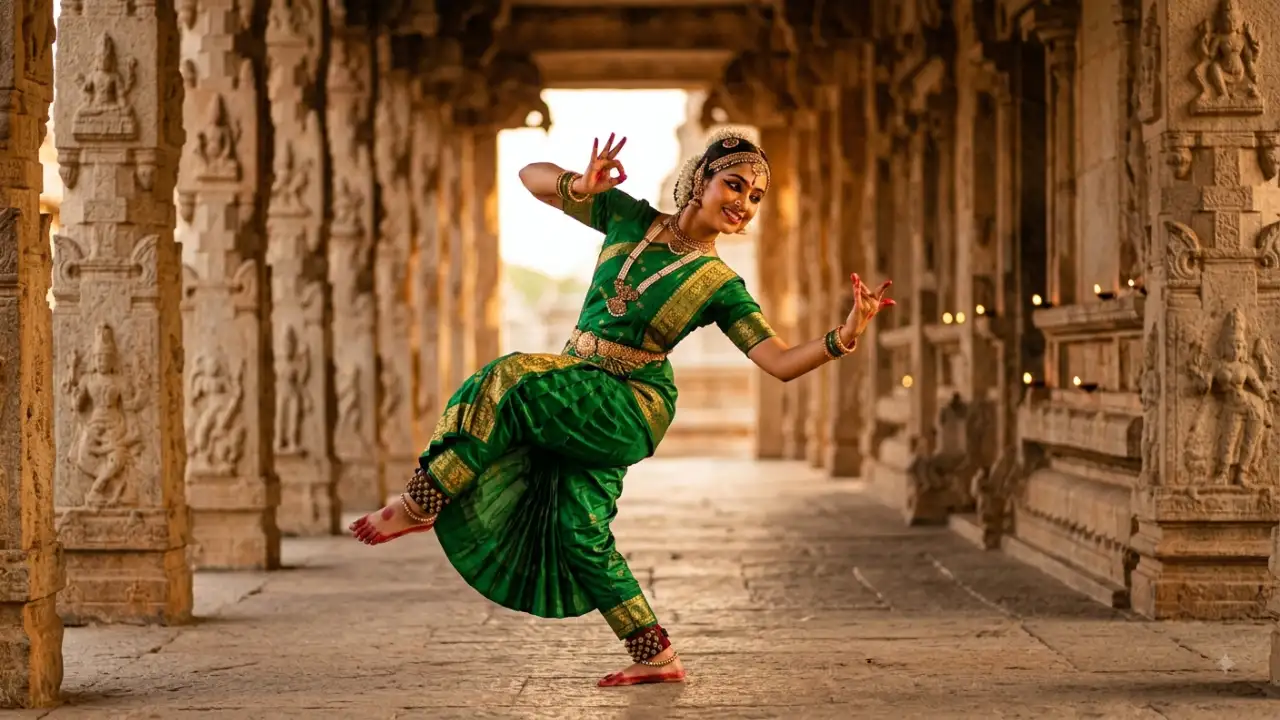
Her pose should clearly reflect classical Bharatanatyam technique and graceful body control. One hand should form a precise Katakamukha mudra, with the fingers naturally positioned and anatomically accurate, while the other arm extends gracefully in a complementary classical dance gesture. Keep one leg naturally bent in the traditional Bharatanatyam stance, with the feet positioned correctly and the knees aligned naturally. Add a subtle controlled backbend to create an expressive and dynamic silhouette while maintaining realistic anatomy and balance. Her posture should look like an authentic trained classical dancer rather than an exaggerated fashion pose.
Adorn her with traditional Bharatanatyam jewelry, including detailed temple-style gold earrings, a traditional maang tikka, elegant necklace, choker, gold bangles, armlets, waist belt, anklets, and traditional dance jewelry. Add traditional Bharatanatyam head ornaments and a beautiful hair arrangement decorated with fresh white jasmine flowers. Her long black hair should be styled into a neat traditional bun or braid, with realistic individual hair strands and natural texture. The jewelry should have intricate South Indian temple-inspired patterns, realistic gold texture, subtle metallic reflections, and accurate proportions.
Her face should have naturally beautiful Indian facial features with a realistic warm Indian skin tone, visible natural skin pores, fine facial texture, expressive eyes, naturally shaped eyebrows, detailed eyelashes, and realistic lips. Apply traditional Bharatanatyam-inspired makeup with clearly defined expressive eyes, subtle eyeliner, natural-looking red lips, gentle blush, and a small traditional bindi. Add subtle classical dance eye makeup while keeping the overall face realistic and believable. Avoid excessive skin smoothing or an artificial beauty-filter appearance.
She should have a graceful and expressive facial expression that reflects the emotion of classical Indian dance. Her eyes should be focused slightly toward the camera with a confident, composed, and artistic expression. Her movements should appear controlled and elegant, with natural tension in the arms and legs. Ensure both hands, fingers, feet, and toes are anatomically correct and clearly visible.
The setting should be a magnificent historic South Indian temple corridor featuring intricately carved stone pillars, traditional sculptures, detailed architectural patterns, ancient stone flooring, temple lamps, carved walls, and subtle floral decorations. The architecture should have realistic stone texture, natural aging, fine carvings, and authentic heritage details. Keep the corridor extending into the distance to create strong visual depth and a cinematic perspective.
Use warm evening sunlight entering from the side of the temple corridor, creating beautiful golden highlights across her face, green silk saree, jewelry, and carved stone architecture. Add soft shadows between the temple pillars and a subtle warm rim light around her hair and shoulders. The golden sunlight should enhance the green and gold color combination naturally without creating excessive glow or artificial reflections. Maintain realistic exposure, natural skin tones, soft light falloff, and cinematic atmospheric depth.
The overall mood should feel graceful, powerful, spiritual, traditional, artistic, and culturally rich. The image should look like a professional Bharatanatyam dance photography session captured inside a real historic temple. Maintain authentic Indian classical dance styling, realistic body proportions, accurate Bharatanatyam posture, natural saree movement, believable jewelry placement, detailed temple architecture, realistic skin texture, and natural lighting.
Capture the photograph using a professional full-frame DSLR or mirrorless camera with an 85mm lens at approximately f/2.0 aperture. Use a full-body vertical composition so the entire dance pose, saree, jewelry, and feet are clearly visible. Keep the dancer sharply focused while allowing the distant temple corridor to gradually fall into a soft cinematic background blur. Capture detailed silk fibers, golden zari patterns, intricate jewelry, individual hair strands, realistic jasmine flowers, natural skin pores, accurate hand gestures, realistic feet and toes, detailed stone carvings, and subtle evening light reflections. Professional Indian classical dance photography, cinematic composition, vibrant but natural colors, shallow depth of field, high dynamic range, ultra HD, 8K, extremely detailed, sharp focus, photorealistic quality.
Negative Prompt
Rainy Kolkata Street Photoshoot
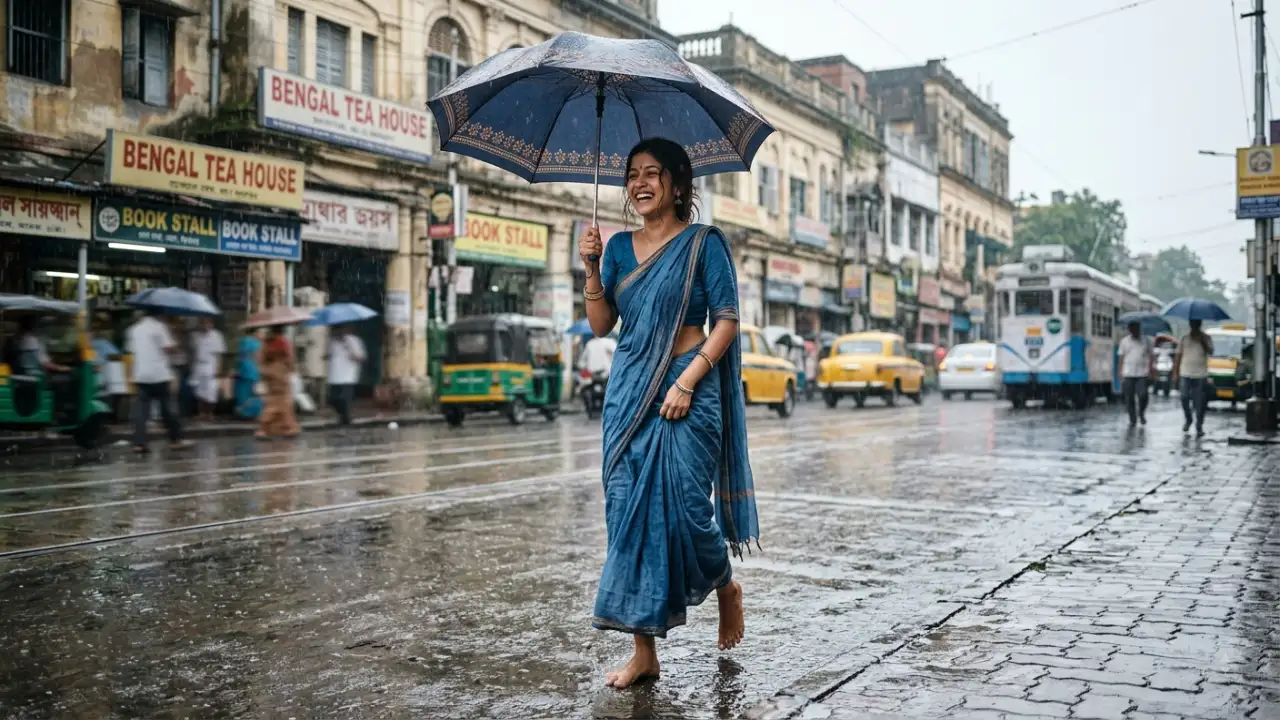
She is holding a simple traditional umbrella above her head with one hand while walking naturally along the wet street. Her other hand gently gathers a small portion of the saree pallu to keep it away from the wet road. Her bare feet should look completely natural, with realistic proportions and subtle water droplets on the skin. Make sure her hands, fingers, feet, and toes are anatomically accurate and naturally positioned. Capture her in a genuine candid moment rather than a carefully staged fashion pose.
Her long dark black hair should look slightly messy and naturally affected by the rain and humid monsoon air. Some damp strands should gently fall around her forehead, cheeks, and shoulders. Show realistic individual hair strands, slight moisture, natural volume, and believable movement caused by the breeze. Avoid making the hairstyle overly polished because the photograph should feel spontaneous and authentic.
Her face should have naturally beautiful Indian features with a realistic warm Indian skin tone, visible natural skin pores, fine facial texture, expressive eyes, natural eyebrows, detailed eyelashes, and realistic lips. Keep her makeup minimal and natural, with subtle eyeliner, soft natural blush, and lightly tinted lips. She is laughing naturally while looking slightly toward the camera, creating a genuine moment of happiness and spontaneity. Her expression should feel authentic, joyful, relaxed, and completely unposed. Avoid an artificial smile or exaggerated facial expression.
Set the scene on a realistic old Kolkata street during the monsoon. Include rain-covered roads, traditional Bengali-style buildings, old balconies, weathered walls, small shops, electrical wires, street signs, parked bicycles, subtle pedestrians carrying umbrellas, and realistic urban details in the distance. Add puddles and small streams of rainwater along the roadside. The wet road should naturally reflect the surrounding buildings, umbrellas, and soft ambient light. Keep the background slightly blurred to maintain focus on the woman while preserving the unmistakable atmosphere of a rainy Kolkata street.
Show gentle rain falling naturally throughout the scene, with small visible droplets around the woman and subtle splashes where rain hits the wet pavement. Her blue cotton saree should interact naturally with the rain and breeze, with the pallu moving softly and the damp fabric becoming slightly heavier. Add realistic water droplets on the umbrella, hair, arms, and saree without making the rain look exaggerated or artificial.
Use soft overcast monsoon lighting created by a cloudy sky. The light should be diffused, gentle, and evenly spread across her face and clothing, with no harsh shadows. Maintain realistic skin tones and natural blue colors while allowing the wet street to create soft reflections. Use subtle atmospheric haze caused by the rain and humidity. Keep the color palette cinematic but natural, with rich blue saree tones, muted urban colors, soft gray skies, and realistic wet-surface reflections.
The image should feel like a spontaneous moment captured by a professional street photographer during the Kolkata monsoon. The woman should appear naturally unaware of the camera, creating a genuine documentary-style atmosphere. Use subtle motion blur in the distant pedestrians, umbrellas, vehicles, and background elements while keeping the woman reasonably sharp. The motion blur should communicate movement without making the main subject blurry.
Capture the photograph using a professional full-frame DSLR or mirrorless camera with a 50mm lens at approximately f/2.8 aperture. Use a medium full-body or three-quarter composition that clearly shows the woman's saree, umbrella, bare feet, and rain-soaked surroundings. Use medium depth of field so her face and clothing remain detailed while the background has a natural cinematic blur. Capture realistic skin pores, individual hair strands, wet cotton fibers, water droplets, umbrella texture, road reflections, puddles, Bengali architecture, and natural rain movement. Professional Indian street photography, authentic Kolkata monsoon atmosphere, candid documentary photography, cinematic composition, natural color grading, soft overcast lighting, realistic motion blur, high dynamic range, ultra HD, 8K, extremely detailed, photorealistic quality.
Negative Prompt
Rooftop Café Lifestyle Image
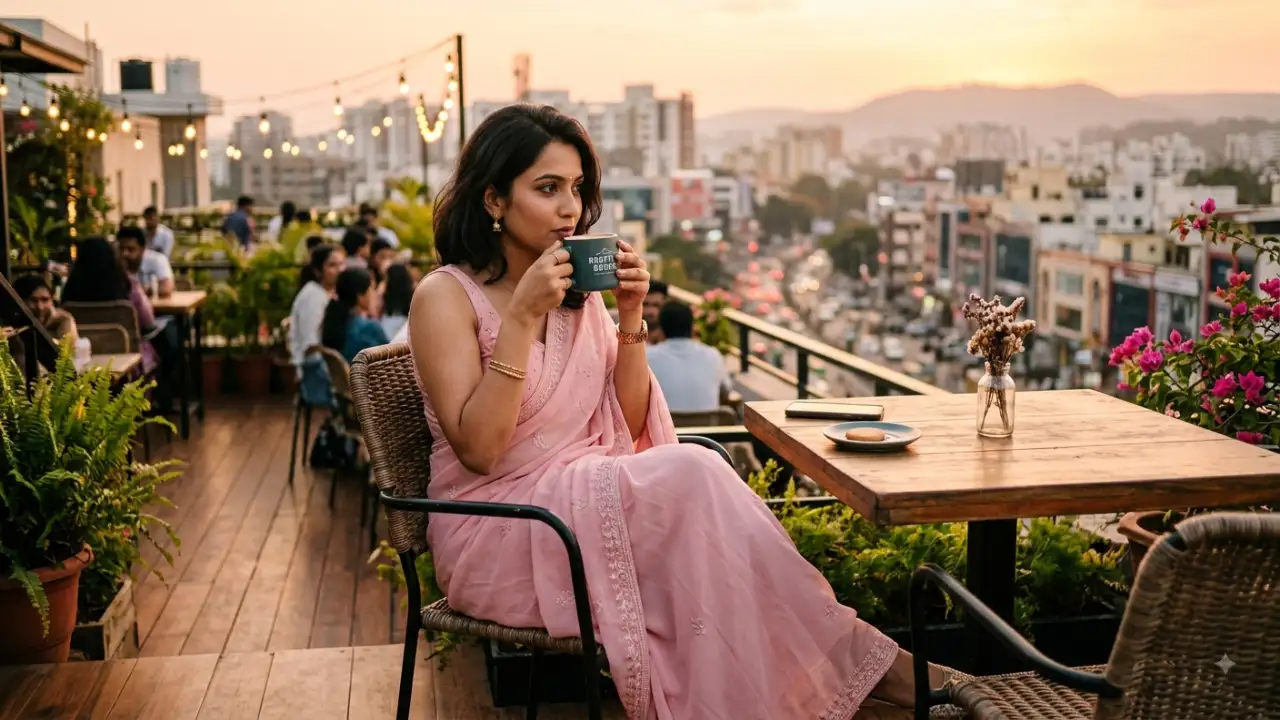
Complete her modern look with elegant minimal accessories, including delicate gold or rose-gold earrings, a thin bracelet, a sophisticated wristwatch, and a few subtle rings. Keep the jewelry refined and fashionable rather than heavily traditional. Her accessories should have realistic metallic textures, natural reflections, fine craftsmanship, and believable proportions. Add a stylish but understated handbag placed naturally beside her chair if appropriate.
Her long, dark black hair should be styled in soft natural waves, falling loosely over her shoulders and back. Include a few fine strands gently moving in the evening breeze. Her hair should have realistic texture, natural volume, and visible individual strands. Her makeup should be modern, soft, and natural, with naturally defined eyebrows, realistic eyelashes, subtle eyeliner, warm neutral eyeshadow, gentle blush, and soft pink or nude lips. Maintain realistic Indian skin tone, visible natural pores, fine facial details, realistic eyes, natural lips, subtle skin imperfections, and authentic facial proportions. Avoid excessive makeup or artificial skin smoothing.
She is sitting comfortably on a stylish rooftop café chair with one leg naturally crossed over the other. She is holding a modern ceramic coffee cup in one hand and gently sipping coffee while looking casually away from the camera. Her expression should be relaxed, thoughtful, confident, and natural, as if enjoying a quiet evening alone. Her body posture should feel effortless rather than posed. Make sure her hands, fingers, legs, and feet are anatomically correct and naturally positioned.
The rooftop café should have a sophisticated urban atmosphere with modern tables and chairs, subtle decorative plants, warm hanging lights, stylish railings, and a beautiful city skyline in the distance. Add softly blurred buildings, distant traffic lights, rooftop structures, and subtle evening activity to create realistic urban depth. Keep the café environment stylish but not overly crowded, allowing the woman to remain the main subject.
Use beautiful soft golden-hour sunlight coming from the side, gently illuminating her face, hair, pastel pink saree, and coffee cup. Create warm highlights along the edges of her hair and saree while maintaining natural skin tones. Add subtle shadows beneath the chair and surrounding objects, realistic light falloff, gentle atmospheric haze, and natural reflections. The golden-hour lighting should feel warm and cinematic without excessive orange tones, artificial glow, or overexposure.
The overall mood should feel relaxed, stylish, modern, feminine, urban, and authentic. The image should look like a professional lifestyle photograph taken for a contemporary fashion or travel magazine. Blend traditional Indian saree styling with modern rooftop café culture while keeping the scene believable and natural. Maintain realistic body proportions, authentic saree draping, natural fabric movement, accurate hands and fingers, realistic coffee cup interaction, natural facial expression, and believable environmental details.
Capture the image using a professional full-frame DSLR or mirrorless camera with a 50mm portrait lens at approximately f/2.0 aperture. Use a medium full-body or three-quarter composition, keeping the woman and her saree in sharp focus while allowing the distant city skyline and café background to gradually fall into a soft cinematic blur. Capture fine georgette fabric texture, delicate blouse details, individual hair strands, realistic skin pores, subtle jewelry reflections, realistic coffee cup texture, rooftop surfaces, and warm evening light. Professional Indian lifestyle photography, urban fashion editorial aesthetic, cinematic composition, natural color grading, soft golden-hour lighting, shallow depth of field, high dynamic range, ultra HD, 8K, extremely detailed, sharp focus, photorealistic quality.
Negative Prompt
Diwali Diya Celebration
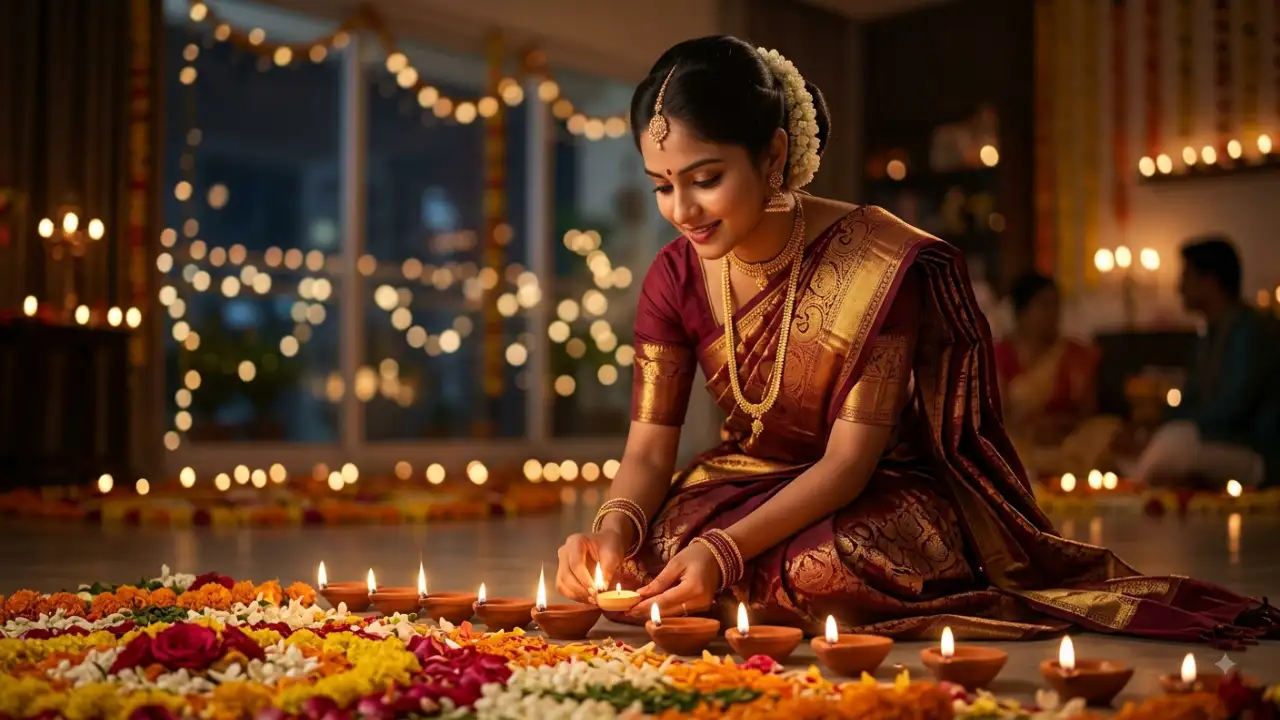
Adorn her with elegant traditional Indian gold jewelry, including detailed gold jhumka earrings, a delicate maang tikka, a traditional necklace, layered gold chains, bangles, elegant rings, and subtle waist jewelry. The jewelry should have intricate craftsmanship, realistic gold texture, natural metallic reflections, and believable proportions. Add fresh jasmine flowers to her traditional hairstyle. Her long dark hair should be neatly styled in a graceful braid or low bun decorated with white jasmine flowers, with a few fine loose strands naturally framing her face.
Her face should have naturally beautiful Indian facial features with a realistic warm Indian skin tone, visible natural skin pores, fine facial details, expressive realistic eyes, naturally shaped eyebrows, detailed eyelashes, and naturally formed lips. Use elegant festive makeup with softly defined eyes, subtle eyeliner, warm eyeshadow, gentle blush, and rich but natural red or maroon lips. Add a small traditional red bindi. Avoid excessive makeup and artificial skin smoothing. Maintain authentic facial proportions and realistic skin texture.
She is kneeling gracefully on a beautifully decorated floor while carefully lighting a row of traditional brass diyas during Diwali. One hand is gently holding a small traditional diya or lighting taper near the flame while the other hand rests naturally for balance. Her eyes are focused calmly on the diya she is lighting, with a subtle, peaceful smile on her face. Her posture should look natural, balanced, and graceful. Make her hands, fingers, knees, feet, and toes anatomically correct and realistically positioned.
The floor should be decorated with an intricate traditional Indian rangoli made with colorful powders and fresh flower petals. Arrange a beautiful row of glowing brass and clay diyas around her, with realistic flames, subtle smoke, natural reflections, and warm light spreading across the floor. Add marigold flowers, rose petals, jasmine flowers, small festive decorations, and elegant Diwali elements around the scene.
The background should feature a beautifully decorated traditional Indian home or courtyard prepared for Diwali. Include warm fairy lights, marigold garlands, hanging decorations, traditional lamps, subtle architectural details, and softly glowing diyas in the distance. Keep the background beautifully blurred with creamy golden bokeh while retaining enough detail to communicate the festive Diwali atmosphere. Avoid overcrowding the scene.
The main light source should come naturally from the diya flames positioned near her hands and face. The warm flames should softly illuminate her face, eyes, fingers, jewelry, and maroon silk saree, creating realistic warm highlights and gentle shadows. Combine the diya light with subtle ambient evening lighting and soft decorative lights in the background. The flame reflections should appear naturally in her eyes without looking artificial. Maintain realistic skin tones, balanced exposure, natural shadows, soft light falloff, and cinematic atmospheric depth.
The overall mood should feel peaceful, festive, traditional, warm, spiritual, and intimate. The photograph should capture a genuine Diwali moment rather than looking like a staged studio image. Maintain realistic interaction between the woman, diya flames, saree, flowers, and decorated floor. Ensure realistic fire behavior, natural fabric movement, authentic Indian styling, accurate body proportions, believable jewelry placement, and natural facial expression.
Capture the photograph using a professional full-frame DSLR or mirrorless camera with an 85mm portrait lens at approximately f/1.8 aperture. Use a low or medium full-body composition that clearly shows the woman kneeling, her saree, the decorated rangoli, and the row of diyas. Keep her face, hands, diya flames, and saree details sharply focused while creating a smooth cinematic bokeh in the background. Capture realistic silk fibers, detailed zari patterns, natural skin pores, individual hair strands, jasmine petals, realistic firelight, diya reflections, rangoli textures, and flower details. Professional Indian Diwali photography, cinematic composition, rich but natural colors, warm firelight, shallow depth of field, high dynamic range, 8K Ultra HD, extremely detailed, sharp focus, photorealistic quality.
Negative Prompt
Vintage Saree Fine Art
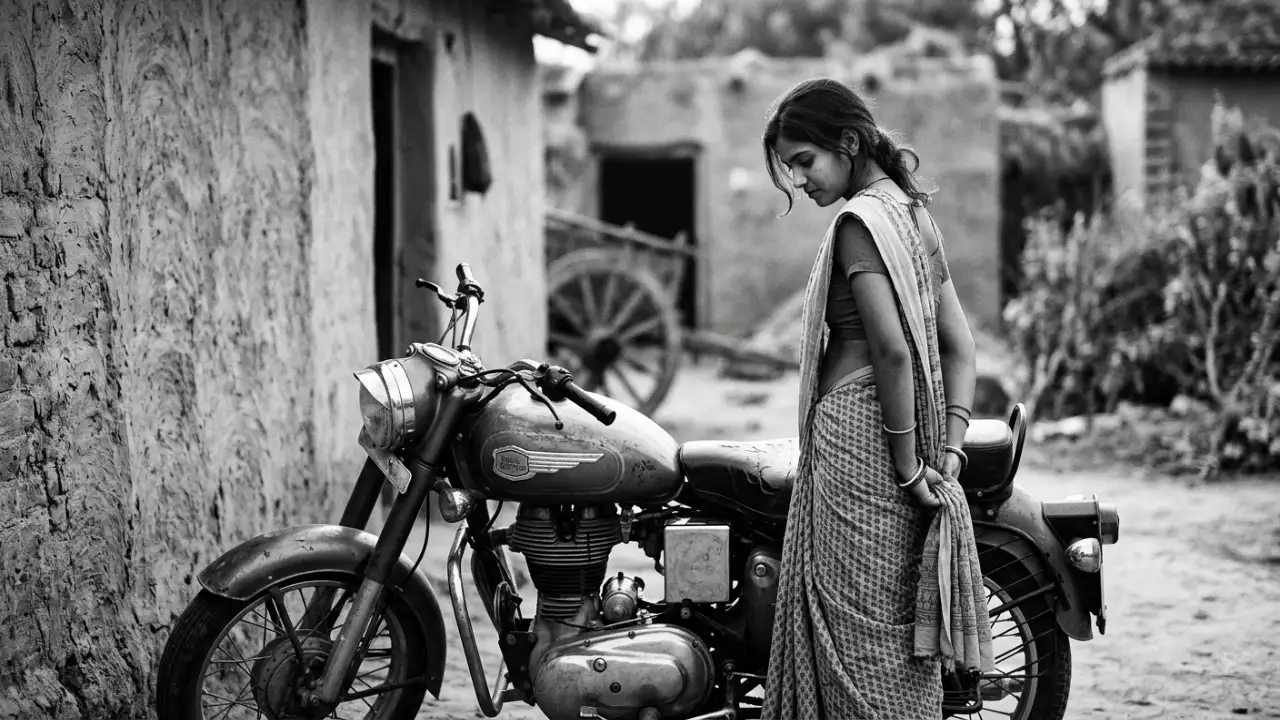
Her hairstyle should be simple and naturally traditional, with long dark hair arranged in a loose braid or low bun. Include a few fine strands of hair around her forehead and cheeks to create an authentic candid appearance. If appropriate, add a few subtle jasmine flowers near the back of her hairstyle. Show individual hair strands, natural volume, and realistic texture rather than a perfectly styled fashion look.
Her face should have naturally beautiful Indian facial features with realistic proportions, authentic skin texture, subtle pores, expressive eyes, natural eyebrows, detailed eyelashes, and naturally shaped lips. Keep her makeup extremely minimal and understated, suitable for a timeless rural portrait. Add a small traditional bindi if desired. Her expression should be shy, peaceful, and gentle. She is looking downward with a soft, modest smile, creating an intimate and emotionally natural moment. Avoid an exaggerated smile or artificial expression.
She is standing beside a classic vintage Enfield-style motorcycle with an authentic old-fashioned appearance. The motorcycle should have realistic metal surfaces, a detailed engine, textured tires, aged paint, chrome components, leather seat, and subtle signs of natural use. She is holding the saree pallu with both hands behind her back, creating a graceful and slightly shy posture. Her shoulders should remain relaxed and her body should be positioned naturally. Make sure both hands, fingers, arms, feet, and body proportions are anatomically correct and realistically positioned.
Place the scene in a peaceful rural Indian village with an authentic countryside atmosphere. Include an old mud-plastered or brick house, weathered walls, a simple wooden doorway, a narrow unpaved path, scattered trees, distant agricultural fields, subtle village structures, and natural vegetation. Add small environmental details such as dry leaves, textured earth, simple farming elements, or a distant bicycle without overcrowding the composition. The setting should feel genuine and lived-in rather than artificially arranged.
Use a classic black-and-white fine art photography aesthetic with carefully controlled tonal range. Create strong but soft directional light that gently illuminates one side of her face while producing elegant shadows on the other side. Use high contrast without losing important details in the dark areas. Preserve beautiful highlights on her saree folds, face, hair, and motorcycle while maintaining rich deep blacks and smooth midtones.
Add authentic analog film characteristics, including subtle grain, fine monochrome texture, gentle film noise, natural tonal variation, slightly softened highlights, realistic shadow detail, and a timeless vintage photographic feeling. The grain should look like professional medium-format or classic 35mm film rather than digital noise. Avoid excessive grain that hides facial or fabric details.
The composition should feel like an award-winning documentary fine art photograph. Frame the woman and motorcycle as the primary subjects while allowing the rural environment to provide context. Use natural negative space and balanced visual proportions. The woman's downward gaze and hands holding the pallu behind her back should create a quiet storytelling moment. Maintain authentic Indian cultural styling without making the image look theatrical or overly posed.
Capture the photograph using a professional full-frame DSLR or vintage film-camera aesthetic with a 50mm or 85mm portrait lens at approximately f/2.8 aperture. Use a medium full-body composition so her complete saree, posture, feet, and motorcycle are visible. Keep her face, saree texture, hands, and motorcycle details sharp while allowing the distant village background to gradually soften. Use realistic perspective, shallow-to-medium depth of field, high tonal detail, natural shadows, subtle film grain, rich black levels, smooth grayscale transitions, high dynamic range, fine art photography, documentary portrait style, timeless Indian rural atmosphere, ultra-detailed, photorealistic black-and-white masterpiece.
Negative Prompt
Temple Jasmine Portrait
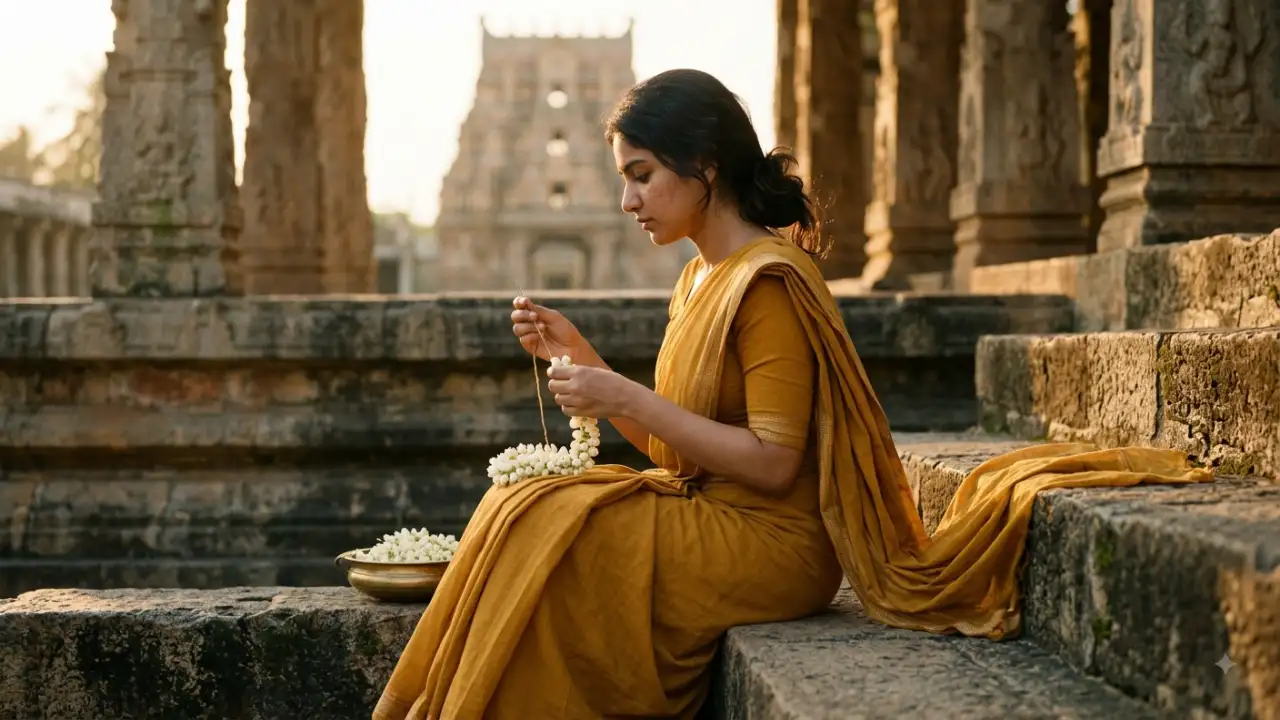
She is sitting comfortably sideways on the weathered temple steps while carefully stringing a fresh jasmine garland with both hands. Her hands should be positioned naturally as she threads the small white jasmine flowers together, creating a genuine traditional moment. Ensure her hands and fingers are anatomically correct, with realistic finger placement and natural interaction with the flowers and thread. The jasmine flowers should have individual delicate petals, natural shapes, subtle imperfections, and realistic freshness.
Her long, dark black hair should be styled naturally in a traditional braid or low bun, with a few loose strands gently framing her face. Add a small arrangement of fresh jasmine flowers near the back of her hairstyle. Show individual hair strands, realistic texture, natural volume, and subtle movement from the afternoon breeze. Avoid an overly polished hairstyle so the portrait retains a genuine, candid feeling.
Her face should have naturally beautiful Indian facial features with authentic proportions, realistic warm Indian skin tone, visible natural skin pores, fine facial texture, expressive eyes, naturally shaped eyebrows, detailed eyelashes, and naturally formed lips. Use minimal and natural makeup with softly defined eyes, subtle eyeliner, gentle blush, and soft natural pink or muted red lips. Add a small traditional bindi on her forehead. She is shown in a graceful profile view, looking gently downward toward the jasmine garland with a peaceful, thoughtful expression and a subtle natural smile.
The ancient temple steps should feature beautifully weathered stone with realistic cracks, subtle discoloration, carved edges, natural surface imperfections, and authentic aged texture. Behind her, include portions of traditional Indian temple architecture, carved stone pillars, decorative sculptures, ornate stone details, and a softly visible temple entrance. Keep the background naturally aged and historically inspired without making it look artificial or overly dramatic.
Place a small collection of fresh jasmine flowers, loose petals, and a traditional thread arrangement beside her on the temple step. Add subtle cultural details such as a small brass container or traditional flower basket without overcrowding the scene. The composition should focus primarily on the woman, her hands, the jasmine garland, and the beautiful texture of the ancient temple surroundings.
Use warm late-afternoon sunlight entering from the side of the temple courtyard. The sunlight should gently illuminate her profile, cheek, hair, saree, hands, and jasmine flowers while creating warm golden highlights along the mustard-yellow fabric. Create soft natural shadows across the stone steps and temple architecture. Use realistic light falloff, subtle atmospheric haze, gentle highlights, and natural warm tones. Avoid excessive glow or artificial lighting.
The overall mood should feel peaceful, traditional, intimate, graceful, and timeless. The photograph should look like a genuine cultural portrait captured by a professional photographer at an ancient Indian temple. Emphasize the quiet beauty of the moment, the tactile quality of the jasmine flowers, the aged stone, and the natural elegance of the woman. Maintain authentic Indian styling, realistic body proportions, natural saree draping, believable fabric movement, accurate hands and fingers, natural facial expression, and realistic environmental details.
Capture the image using a professional 35mm film camera aesthetic with a 50mm lens at approximately f/2.8 aperture. Use a medium full-body or three-quarter profile composition, clearly showing her side profile, saree, hands, jasmine garland, and temple steps. Keep her profile, hands, flowers, and saree texture sharply detailed while allowing the distant temple architecture to gradually soften. Add authentic 35mm film characteristics, subtle fine grain, natural film texture, smooth highlight roll-off, gentle contrast, soft shadows, realistic skin tones, warm analog color rendering, natural depth of field, cinematic composition, high detail, ultra-realistic photography, timeless Indian fine art portrait quality.
Negative Prompt
Kitchen Roti Making Photoshoot
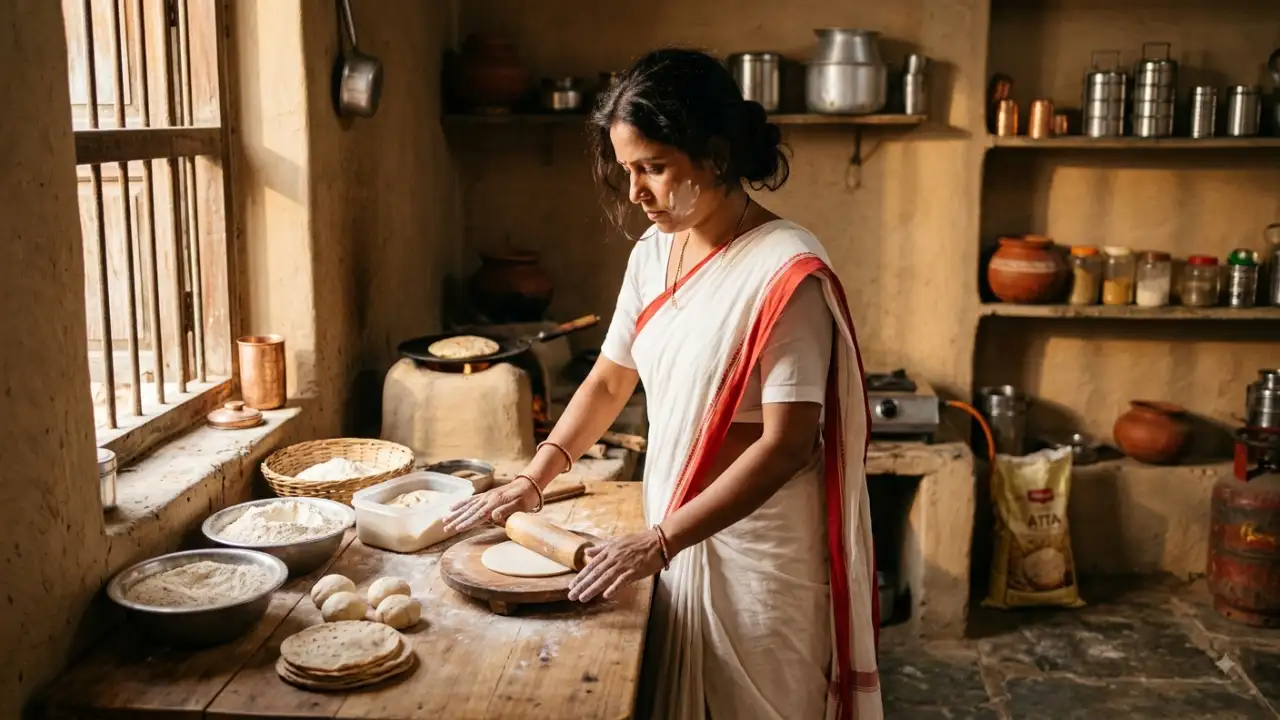
She is standing beside a traditional kitchen counter or wooden work surface, actively rolling dough for rotis using a simple wooden rolling pin. A small round piece of dough should be placed naturally on a lightly floured wooden board in front of her. Show realistic flour scattered across the work surface, a traditional metal or brass bowl containing dough, a small container of flour, and a few freshly prepared rotis nearby. Her hands should be naturally engaged in the cooking process, with anatomically correct fingers and realistic interaction with the rolling pin and dough.
Add a subtle, realistic dusting of wheat flour on one side of her cheek, along with tiny traces of flour on her fingers and hands. The flour should look natural and understated rather than exaggerated. Her expression should be focused, calm, and slightly thoughtful as she concentrates on preparing the roti. She should not pose directly for the camera; instead, capture her during a genuine everyday moment, creating the feeling of an authentic candid photograph.
Her long dark black hair should be styled simply and practically, such as a low braid or loosely tied-back hairstyle suitable for working in a traditional kitchen. Include a few natural loose strands around her forehead and face. Show realistic individual hair strands, natural texture, and believable volume. Avoid an overly polished hairstyle because the image should feel genuine and documentary-like.
Her face should have naturally beautiful Indian facial features with authentic proportions, realistic warm Indian skin tone, visible natural skin pores, subtle facial texture, expressive eyes, naturally shaped eyebrows, detailed eyelashes, and naturally formed lips. Keep her makeup extremely minimal and natural, with perhaps only subtle eyeliner and naturally toned lips. Add a small traditional red bindi if appropriate. Maintain realistic skin imperfections and natural facial details rather than creating a heavily edited beauty look.
The rustic kitchen should have an authentic lived-in Indian atmosphere with aged plaster walls, exposed brick or slightly weathered surfaces, wooden shelves, traditional stainless-steel or brass utensils, earthen containers, a simple stove, copper or brass cooking vessels, hanging kitchen tools, and natural everyday details. Include realistic signs of cooking such as a lightly flour-covered counter, dough marks, wooden utensils, and neatly arranged ingredients. Avoid making the kitchen look overly clean, luxurious, or artificially decorated.
Use soft natural window light entering from the left side of the frame. The light should gently illuminate her face, cheek, hands, rolling board, dough, and white cotton saree while creating soft realistic shadows on the opposite side. Allow the red saree border to receive subtle warm highlights. Maintain natural skin tones and realistic exposure. Use gentle light falloff, soft shadow transitions, and subtle atmospheric warmth without excessive glow or artificial lighting.
The overall mood should feel homely, warm, intimate, simple, authentic, and nostalgic. The photograph should tell a small everyday story about traditional Indian home cooking. It should look like a genuine documentary photograph captured naturally in a real family kitchen rather than a staged fashion photoshoot. Preserve realistic body proportions, natural posture, accurate hands and fingers, believable cooking movements, authentic saree draping, realistic flour texture, and detailed kitchen elements.
Capture the photograph using a professional full-frame DSLR or mirrorless camera with a 50mm lens at approximately f/2.8 aperture. Use a medium portrait or three-quarter composition that clearly shows the woman, her hands, rolling pin, dough, and part of the rustic kitchen. Keep her face and hands sharply detailed while allowing the deeper kitchen background to gradually soften with a natural depth of field. Capture realistic cotton fibers, individual hair strands, natural skin pores, flour particles, dough texture, wooden surfaces, metal utensils, and subtle window-light reflections. Professional Indian documentary photography, authentic home lifestyle photography, warm natural color grading, candid composition, soft window lighting, realistic textures, high dynamic range, ultra HD, 8K, extremely detailed, photorealistic quality.
Negative Prompt
Purple Saree City Lights
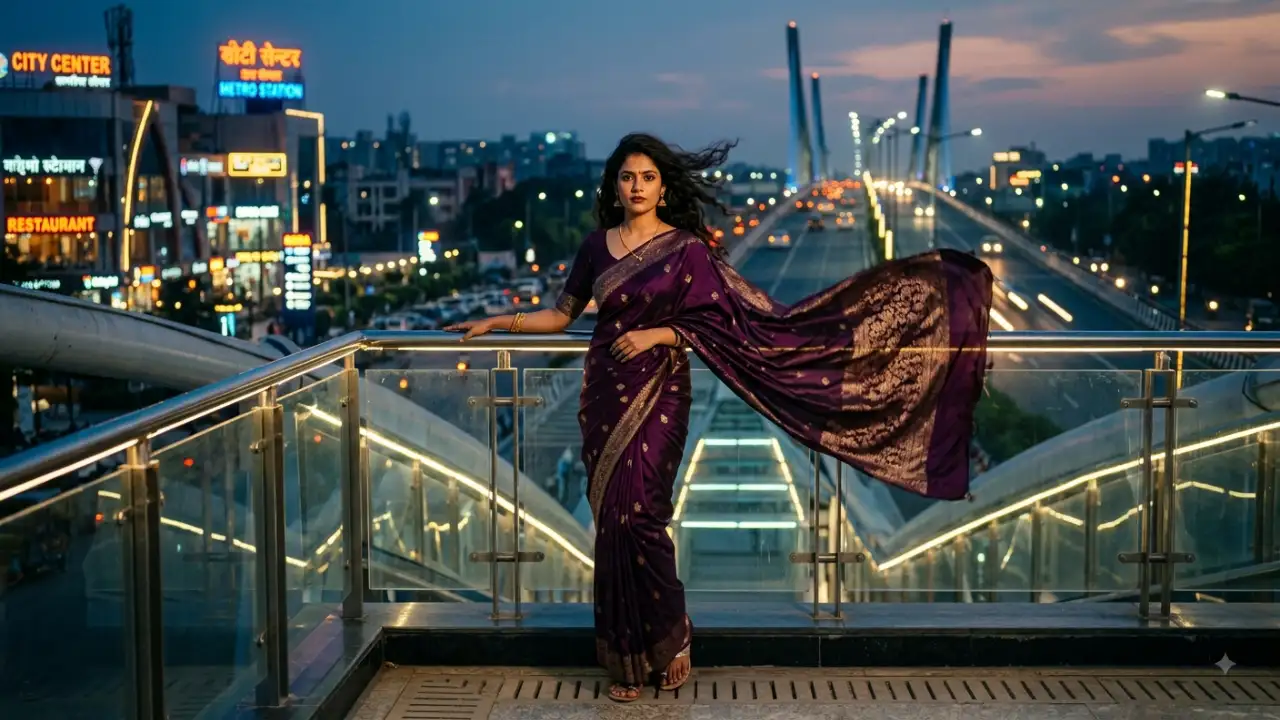
Complete her sophisticated look with carefully selected luxury accessories. Add elegant statement earrings, a delicate necklace, a refined bracelet, a premium wristwatch, and a few minimal rings. The jewelry should complement the dark purple saree without overpowering it. Use realistic metallic textures, intricate craftsmanship, subtle reflections, and natural proportions. Keep the overall styling modern, fashionable, luxurious, and polished.
Her long, dark black hair should be naturally loose and styled in soft waves, with the evening wind gently blowing several strands around her face and shoulders. The hair should move naturally in the same direction as the saree pallu, creating a dynamic sense of motion. Show realistic individual hair strands, natural volume, subtle flyaway hairs, and believable movement rather than perfectly fixed hair.
Her face should have naturally beautiful Indian facial features with authentic proportions, realistic warm Indian skin tone, visible natural skin pores, fine facial texture, expressive eyes, naturally shaped eyebrows, detailed eyelashes, and realistic lips. Use sophisticated but natural makeup with softly defined eyes, subtle eyeliner, neutral eyeshadow, gentle blush, and deep rose or muted berry-colored lips. Add a small elegant bindi if desired. Maintain realistic skin texture and subtle natural imperfections. Avoid excessive makeup, artificial skin smoothing, or a plastic beauty-filter appearance.
She is leaning confidently against a sleek modern bridge railing at dusk. Her body should be positioned naturally at a slight angle, with one shoulder relaxed against the railing while the other side of her body faces toward the camera. One leg can be placed slightly forward or crossed naturally at the ankle to create a sophisticated fashion pose. Her arms and hands should rest naturally, with anatomically correct hands, fingers, legs, and feet. She looks directly into the camera with a strong, confident, calm, and sophisticated expression. Her gaze should feel powerful yet natural, like a professional fashion model during an evening editorial photoshoot.
The bridge should have a modern urban design with sleek metal or glass railings, realistic structural details, textured pavement, subtle architectural elements, and a wide cityscape extending into the background. Add numerous distant city lights, illuminated buildings, moving vehicle lights, and subtle reflections on nearby surfaces. Include tasteful neon accents in the environment, such as soft pink, purple, cyan, or warm urban lighting, but keep them naturally integrated into the scene without overpowering the woman.
Use the transition period between sunset and night as the main atmosphere. The sky should have deep blue and purple dusk tones with a subtle remaining glow near the horizon. Combine soft ambient twilight with colorful city lights and gentle neon reflections. Add a subtle rim light around her hair and saree to separate her from the darker background. The lighting should create realistic highlights on the purple silk fabric, jewelry, and face while preserving natural Indian skin tones.
The wind should be an important visual element. Her hair and saree pallu should move naturally in the same direction, with realistic fabric physics and believable motion. The silk should flow softly rather than appearing stiff or floating unnaturally. Capture a few loose hair strands crossing near her face while keeping her facial features clearly visible.
The overall mood should feel confident, glamorous, modern, cinematic, sophisticated, and urban. The image should look like a premium Indian fashion editorial photographed on a real city bridge at dusk. Blend traditional Indian saree styling with contemporary metropolitan fashion while maintaining realistic proportions, natural body language, authentic fabric movement, believable lighting, and detailed environmental depth.
Capture the photograph using a professional full-frame DSLR or mirrorless camera with an 85mm lens at approximately f/2.0 aperture. Use a full-body vertical composition with the entire saree, footwear, pose, bridge railing, and city background visible. Keep her face, body, saree texture, and jewelry sharply detailed while allowing distant city lights to transform into smooth cinematic bokeh. Capture fine silk fibers, delicate embroidery, individual hair strands, realistic skin pores, accurate jewelry reflections, detailed bridge surfaces, realistic city lights, subtle neon reflections, and natural atmospheric depth. Professional Indian fashion editorial photography, urban night fashion aesthetic, cinematic color grading, vibrant but natural colors, shallow depth of field, high dynamic range, ultra HD, 8K, extremely detailed, sharp focus, photorealistic quality.
Negative Prompt
Teal Saree Veena Painting
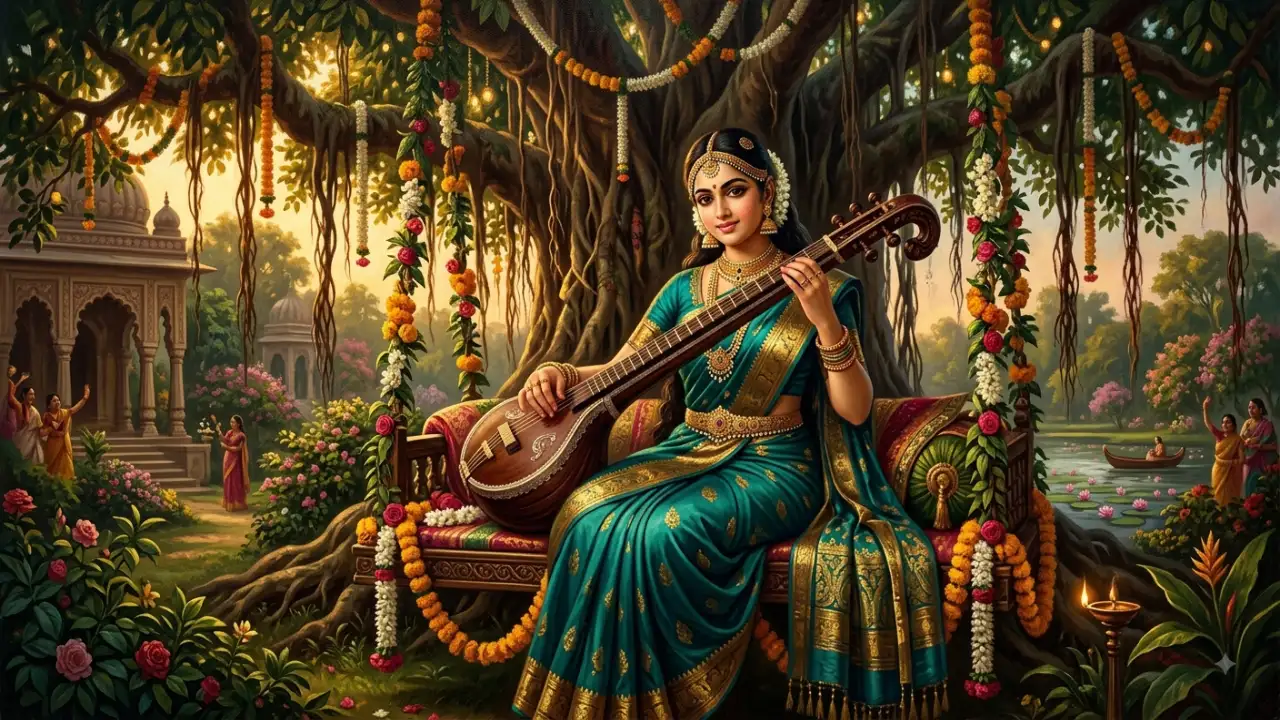
She is wearing a luxurious rich teal-green silk saree with an elegant golden zari border and intricate traditional woven motifs. The saree should have a deep jewel-toned teal color with subtle variations created by the folds of the silk. Show realistic silk texture, delicate woven patterns, natural pleats, graceful fabric folds, soft creases, and carefully painted highlights along the golden border. The saree should be draped in an authentic traditional Indian style, with the pallu falling naturally over one shoulder and cascading elegantly around her body. Pair it with a matching teal silk blouse featuring subtle golden embroidery and traditional detailing.
Adorn her with exquisite traditional Indian gold jewelry, including layered gold necklaces, a detailed temple-style necklace, elegant gold jhumka earrings, delicate bangles on both wrists, traditional armlets, a refined waist ornament, small gold rings, and a graceful maang tikka. The jewelry should feature intricate handcrafted patterns inspired by traditional Indian temple ornaments. Paint every jewelry piece with fine detail, realistic metallic highlights, warm golden reflections, and subtle signs of handcrafted texture rather than making it look digitally glossy.
Her long, dark black hair should be styled traditionally and arranged gracefully behind her shoulders, with a portion of the hair falling naturally down her back. Decorate the hairstyle with fresh white jasmine flowers tucked elegantly around the hair. Include a few naturally loose strands around her forehead and cheeks. Her hair should have detailed individual strands and soft painterly texture while retaining the appearance of traditional oil-paint brushwork.
Her face should have naturally beautiful Indian features with graceful proportions, expressive dark eyes, naturally shaped eyebrows, detailed eyelashes, a softly defined nose, naturally shaped lips, and a peaceful expression. Add a small traditional red bindi on her forehead. Her skin should have a warm natural Indian complexion with subtle tonal variations, delicate highlights, realistic facial structure, and carefully rendered skin texture. Avoid an overly smooth digital appearance; the skin should look like it has been carefully painted with layered oil pigments.
She is seated gracefully on a beautifully carved wooden swing suspended from the large branches of the banyan tree. The swing should have an antique handcrafted appearance with detailed wood carvings, subtle floral motifs, aged wooden texture, and decorative ropes wrapped with small flowers. She holds a richly decorated traditional veena across her lap with both hands. The veena should be historically inspired, beautifully carved, and decorated with intricate traditional patterns, polished wooden surfaces, ornamental details, and realistic strings. Her hands should interact naturally with the instrument, with anatomically correct fingers and believable hand positioning.
Her posture should be relaxed and elegant, with her body slightly turned toward the viewer. One hand rests naturally on the veena strings while the other supports the instrument gracefully. Her shoulders should remain relaxed and her head should be tilted slightly to one side. Her expression should communicate tranquility, wisdom, devotion, and quiet confidence. The composition should feel like a timeless mythological scene while keeping her appearance human, realistic, and emotionally believable.
The enormous banyan tree should dominate the upper portion of the composition, with a thick ancient trunk, sprawling branches, hanging aerial roots, dense green leaves, and natural variations in bark texture. Wrap portions of the swing with delicate jasmine and small flowering vines. The tree should create a natural frame around the woman, giving the composition depth and visual balance. Include detailed leaves, branches, roots, small flowers, and subtle natural imperfections throughout the environment.
Place a peaceful Indian landscape in the background, with a calm reflective pond, distant traditional temple architecture, soft green vegetation, flowering plants, and a subtle misty horizon. Add a few lotus flowers near the water and distant trees fading gently into atmospheric perspective. The background should feel inspired by an idealized Indian landscape rather than a specific identifiable location. Keep the environment rich in detail but ensure that the woman and veena remain the primary focus.
Use dramatic yet soft directional lighting inspired by classical oil painting. Warm golden light should enter through the banyan leaves and gently illuminate the woman's face, teal silk saree, gold jewelry, veena, and parts of the swing. Create carefully controlled highlights on her face and jewelry while allowing portions of the tree and background to fall into deeper warm shadows. Use subtle chiaroscuro, atmospheric light, soft golden rays, rich midtones, deep shadows, and gradual tonal transitions.
The color palette should feature rich teal, antique gold, warm brown, deep green, muted crimson accents, earthy ochre, and soft cream tones. Keep the colors sophisticated and harmonious rather than overly saturated. The golden jewelry and teal saree should provide the main visual contrast against the earthy banyan tree and muted landscape.
The painting should have visible but refined oil-paint texture, with layered brushwork, subtle impasto in selected areas, soft blended transitions on the face and skin, detailed brushwork in the saree and jewelry, and painterly texture throughout the background. The final artwork should feel like a carefully hand-painted museum-quality Indian classical portrait rather than a digital illustration or modern fantasy artwork.
Create a balanced vertical composition with the woman as the central subject, the banyan tree forming a natural frame around her, and the veena providing an elegant diagonal visual element across the composition. Maintain realistic human proportions, anatomically correct hands and fingers, natural facial structure, authentic Indian clothing, believable jewelry placement, detailed instrument construction, and consistent lighting throughout the painting.
Overall aesthetic: classical Indian fine art, historical Indian portrait painting, romantic mythological atmosphere, realistic human figure, traditional Indian elegance, dramatic chiaroscuro lighting, richly layered oil pigments, sophisticated earthy color palette, detailed textile rendering, intricate gold jewelry, handcrafted veena, atmospheric Indian landscape, museum-quality artwork, timeless composition, highly detailed oil painting, refined brushwork, realistic yet poetic, masterpiece quality.
Negative Prompt
Emerald Green Kanjeevaram Silk Saree
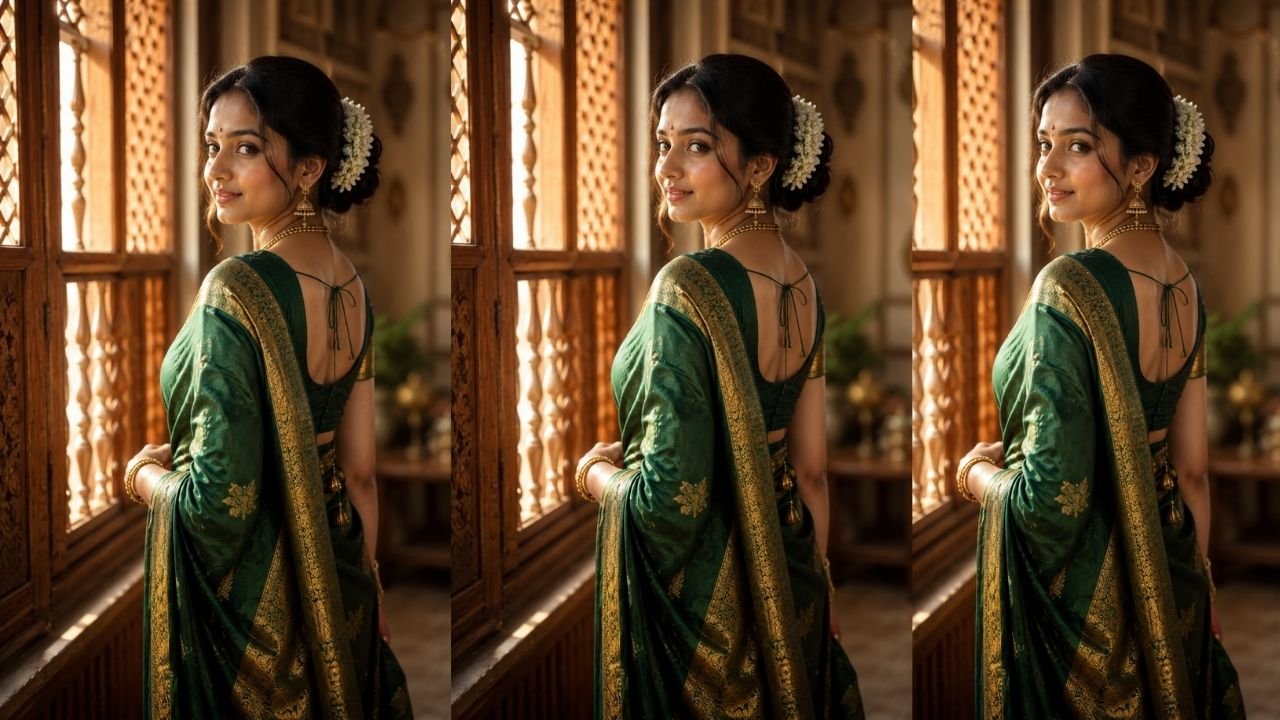
Drape the saree in an elegant and authentic traditional Indian style, with the pallu falling naturally over one shoulder and extending gracefully along her body. The fabric should respond naturally to gravity and movement, with realistic folds around the waist and arm. Pair the saree with a beautifully tailored deep emerald green blouse featuring an elegant traditional open-back design, delicate golden detailing, neat stitching, a refined neckline, and realistic silk fabric texture. The blouse should look sophisticated and tasteful while maintaining authentic Indian fashion styling.
Adorn her with elegant traditional South Indian gold jewelry, including finely detailed gold jhumka earrings, a delicate traditional gold necklace, subtle layered chains, thin gold bangles on both wrists, small elegant rings, and minimal traditional accessories. Every jewelry piece should have realistic craftsmanship, intricate detailing, natural proportions, authentic gold texture, and subtle metallic reflections. The jewelry should complement the emerald green saree without appearing excessive or artificial.
Her long, dark black hair should be styled into a neat and elegant low bun at the back of her head. Decorate the bun with a beautiful arrangement of fresh white jasmine flowers, naturally placed around the hairstyle. Include a few fine loose strands of hair around her forehead, temples, and cheek to maintain a realistic appearance. Show individual hair strands, natural hair texture, realistic volume, and subtle imperfections.
Her face should look naturally beautiful and authentic, with realistic Indian facial features, natural facial proportions, expressive dark brown eyes, naturally shaped eyebrows, detailed eyelashes, a softly defined nose, naturally shaped lips, and realistic facial structure. Add a small traditional red bindi centered naturally on her forehead. Her makeup should be soft, elegant, and minimal, featuring subtle eyeliner, naturally defined brows, warm neutral eyeshadow, gentle blush, and soft natural pink or muted rose lips. Preserve realistic Indian skin tone, visible natural pores, fine skin texture, subtle facial imperfections, natural highlights, and realistic complexion. Avoid excessive makeup, artificial skin smoothing, or a plastic beauty-filter appearance.
She is standing sideways beside a beautifully carved traditional wooden window inside an elegant Indian heritage-style home. Her body should be positioned naturally at a slight three-quarter angle, with her shoulders turned partially away from the camera. She gently looks back over her shoulder toward the camera with a soft, graceful, warm, and natural smile. Her expression should feel calm, feminine, confident, and authentic rather than heavily posed.
One hand should gently hold the edge of the saree pallu near her waist while the other arm rests naturally beside her body. Her hands and fingers must be anatomically correct, naturally positioned, and realistically detailed. The pose should feel effortless and elegant, with natural body proportions and realistic posture. Avoid exaggerated fashion-model poses or unnatural body twisting.
The traditional wooden window should be highly detailed, featuring intricate Indian-style carvings, handcrafted wooden panels, decorative latticework, natural wood grain, subtle signs of age, and warm brown tones. Soft early-morning sunlight should enter through the window and fall naturally across one side of her face, shoulder, hair, jewelry, and emerald green silk saree. The sunlight should create delicate golden highlights along the zari border and individual strands of her hair.
Set the scene inside a sophisticated traditional Indian home with warm cream-colored walls, handcrafted wooden furniture, subtle traditional artwork, brass decorative objects, small indoor plants, and tasteful warm-colored décor. Keep these background elements softly blurred so they provide atmosphere without distracting from the woman. The interior should feel elegant, peaceful, authentic, and lived-in rather than overly luxurious or artificial.
Use soft early-morning natural lighting with warm golden tones. The sunlight should illuminate her face gently while maintaining realistic skin tones and natural shadows. Create a subtle warm rim light around her hair and shoulders, soft highlights on the emerald silk and gold jewelry, realistic shadow transitions, gentle light falloff, and natural atmospheric depth. Avoid excessive glow, overexposure, artificial lens effects, or overly orange color grading.
The overall mood should be elegant, peaceful, traditional, feminine, warm, and sophisticated. The image should look like a genuine professional Indian fashion and lifestyle photograph captured inside a heritage Indian home during the early morning. Maintain authentic Indian styling, realistic saree draping, believable fabric physics, natural facial expression, accurate hands and fingers, realistic jewelry placement, individual hair strands, and detailed architectural elements.
Capture the photograph using a professional full-frame DSLR or mirrorless camera with a 50mm portrait lens at approximately f/1.8 aperture. Use a medium portrait composition, approximately from the waist upward, with the woman's face, eyes, jewelry, jasmine flowers, and saree texture in sharp focus. Create a soft, creamy cinematic bokeh behind her, gradually blurring the carved wooden window and warm interior décor. Use realistic perspective, shallow depth of field, high dynamic range, natural color grading, subtle cinematic contrast, detailed skin texture, realistic silk fibers, intricate zari work, professional Indian fashion photography, ultra HD, 8K, extremely detailed, sharp focus, photorealistic quality.
Negative Prompt
Lavender Organza Window Portrait
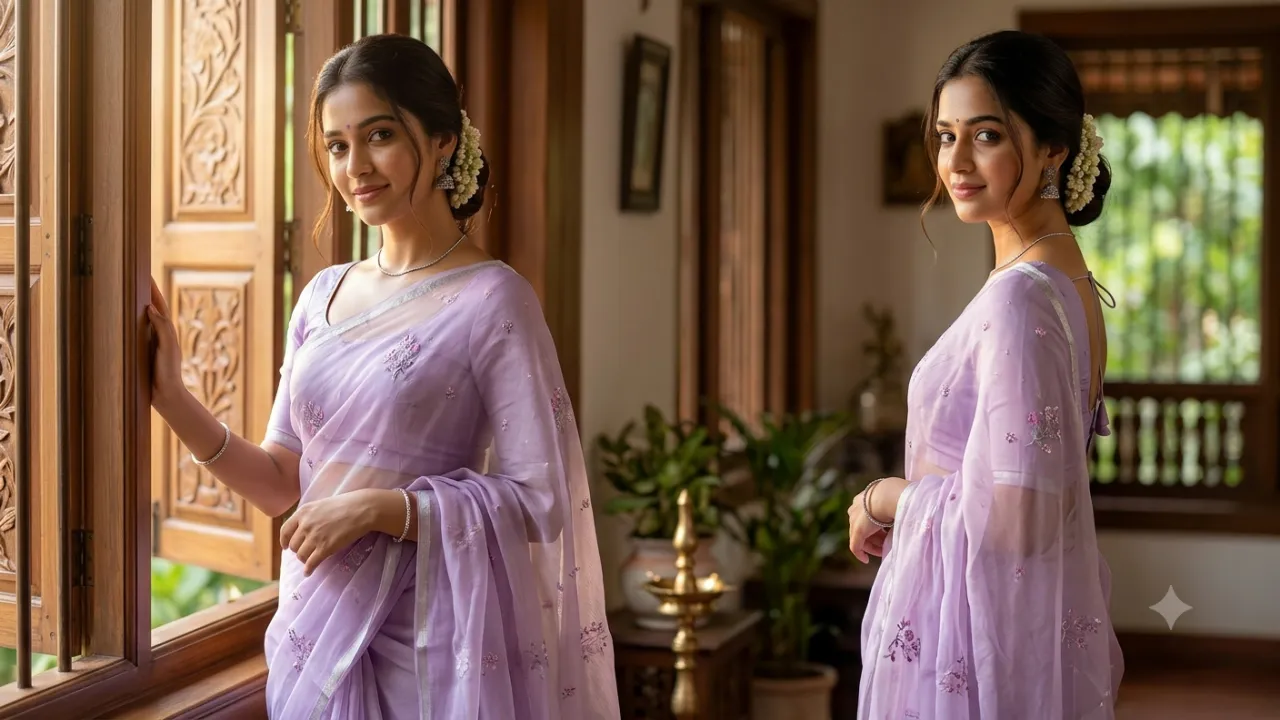
Drape the saree naturally in an elegant Indian style, with the pallu falling gracefully over one shoulder and extending naturally along her body. One hand gently gathers the saree pallu near her waist, allowing the embroidered organza fabric to form soft natural folds and delicate layered textures. The pallu should respond naturally to gravity and a very light morning breeze. Pair the saree with a fitted pastel lavender blouse featuring a refined neckline, elegant tailoring, minimal embroidery, delicate stitching, and realistic fabric texture. The blouse should complement the saree without distracting from its delicate floral embroidery.
Complete her sophisticated appearance with delicate silver jewelry, including elegant silver jhumka earrings, a thin silver necklace, minimal silver bangles, a few subtle rings, and a tiny lavender or neutral-toned bindi. The jewelry should have fine traditional craftsmanship, realistic silver texture, subtle metallic reflections, natural proportions, and delicate detailing. Keep the jewelry minimal and refined to match the soft pastel aesthetic rather than making the look heavily traditional.
Her long, dark black hair should be styled into a graceful low bun at the back of her head, with a few naturally loose strands softly framing her forehead, temples, and cheeks. Decorate the bun with small fresh white flowers arranged naturally. Show individual hair strands, realistic texture, natural volume, and subtle imperfections. Avoid an overly perfect hairstyle so the portrait retains a natural and authentic appearance.
Her face should have naturally beautiful Indian facial features with realistic proportions, expressive dark brown eyes, naturally shaped eyebrows, detailed eyelashes, a softly defined nose, naturally shaped lips, and an authentic warm Indian complexion. Preserve realistic skin texture with visible natural pores, subtle fine lines, delicate facial details, natural highlights, and minor imperfections. Her makeup should be soft and understated, featuring subtle eyeliner, lightly defined brows, neutral eyeshadow, a gentle natural blush, and soft nude-pink lips. Avoid heavy makeup, excessive contouring, artificial skin smoothing, or a plastic beauty-filter appearance.
She is standing sideways beside an old-fashioned carved wooden window inside a traditional Indian interior. Her body should be positioned naturally at a slight three-quarter angle, with her shoulders gently turned toward the window while her face turns back toward the camera. She looks over her shoulder with a soft, charming, warm, and natural smile. Her expression should feel peaceful, graceful, confident, and genuinely relaxed rather than posed. Her posture should remain elegant and anatomically natural.
The wooden window should feature beautiful traditional Indian craftsmanship, including intricate hand-carved patterns, decorative latticework, detailed wooden panels, natural wood grain, subtle aging, and warm brown tones. Through the window, show soft natural greenery, blurred leaves, and hints of a peaceful garden outside. The morning light should pass through the window naturally and create beautiful patterns of light and shadow across the interior.
Set the background inside a sophisticated traditional Indian home featuring warm wooden architecture, subtle handcrafted furniture, traditional decorative objects, muted cream or beige walls, small brass elements, tasteful artwork, and soft natural greenery outside the window. Keep all background elements gently blurred to maintain a clean editorial composition. The setting should feel authentic, elegant, peaceful, and lived-in rather than overly decorated.
Use soft early-morning sunlight entering through the carved wooden window from one side. The light should gently illuminate one side of her face while creating subtle natural shadows on the opposite side. Allow the sunlight to pass softly through portions of the organza pallu, revealing its delicate texture and embroidery in a realistic way. Create subtle highlights on the silver border, earrings, necklace, and hair while maintaining natural skin tones. Use realistic light falloff, soft shadows, delicate reflections, and gentle atmospheric depth. Avoid excessive glow, artificial light rays, or overexposure.
The overall mood should feel soft, feminine, elegant, peaceful, romantic, and sophisticated. The image should resemble a high-end Indian fashion editorial photograph captured inside a heritage-style home during a quiet morning. The pastel lavender color palette, delicate organza texture, silver jewelry, warm wooden window, and natural greenery should work together harmoniously. Maintain realistic body proportions, authentic saree draping, believable translucent fabric behavior, accurate hands and fingers, natural facial expression, realistic hair movement, and detailed embroidery.
Capture the photograph using a professional full-frame DSLR or mirrorless camera with a 50mm portrait lens at approximately f/1.8 aperture. Use a medium portrait composition, approximately from the waist upward, with her face, eyes, jewelry, hair, and saree embroidery in sharp focus. Create a smooth, creamy cinematic bokeh in the carved wooden window and traditional interior while keeping enough environmental detail to establish the setting. Capture fine organza fibers, individual embroidery threads, delicate silver border details, realistic skin pores, individual hair strands, flower petals, natural wood grain, and soft morning light. Professional Indian fashion editorial photography, elegant lifestyle portrait, natural color grading, soft cinematic lighting, shallow depth of field, realistic shadows, high dynamic range, ultra HD, 8K, extremely detailed, sharp focus, highly photorealistic quality.
Negative Prompt
Navy Blue Saree Portrait
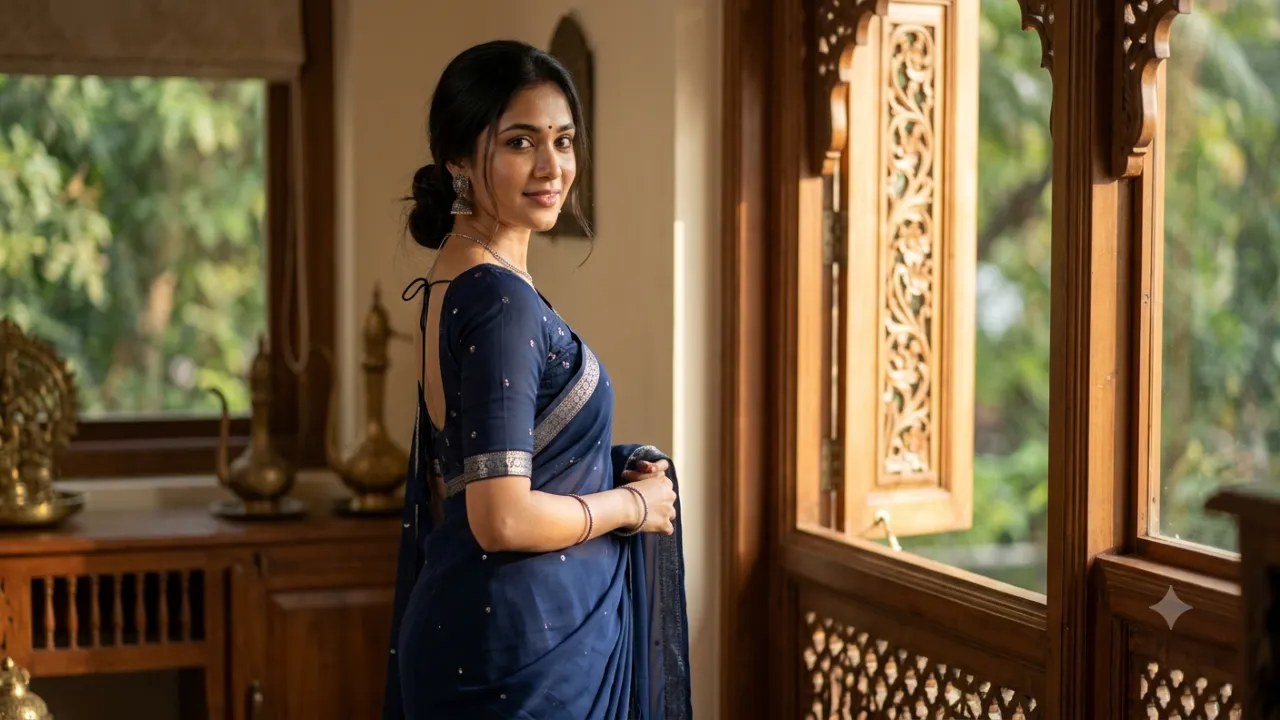
Drape the saree naturally in an elegant contemporary Indian style, with the pallu falling gracefully over one shoulder and extending naturally along her body. One hand gently holds the pallu near her waist, allowing the lightweight georgette fabric to gather into realistic folds. Pair the saree with a sophisticated matching navy-blue blouse featuring subtle embroidery, precise tailoring, a refined neckline, fine stitching, and an elegant traditional back design. The blouse should have a premium fabric texture and complement the saree without overpowering its delicate details.
Adorn her with elegant oxidized-silver jewelry, including detailed traditional jhumka earrings, a delicate silver necklace, slim silver bangles, a few minimal rings, and a small dark-red bindi. The jewelry should have authentic handcrafted detailing, realistic oxidized-silver texture, subtle metallic reflections, natural proportions, and fine traditional patterns. Keep the accessories elegant and balanced, creating a sophisticated contrast against the deep navy-blue saree.
Her long, naturally dark black hair should be styled into a soft and graceful low bun at the back of her head. Leave a few naturally loose strands around her forehead, temples, and cheeks. The hair should show individual strands, realistic texture, natural volume, and subtle imperfections. Avoid an overly polished or artificial hairstyle so the portrait maintains a genuine editorial photography feel.
Her face should have naturally beautiful and authentic Indian facial features, realistic facial proportions, expressive dark brown eyes, naturally shaped eyebrows, detailed eyelashes, a softly defined nose, naturally shaped lips, and a realistic Indian skin tone. Preserve visible natural skin pores, fine facial lines, subtle texture, natural highlights, and minor imperfections. Her makeup should be elegant and understated, featuring softly defined eyes, subtle eyeliner, neutral eyeshadow, gentle blush, naturally shaped brows, and soft muted-rose or natural pink lips. The dark-red bindi should be positioned naturally at the center of her forehead. Avoid heavy makeup, excessive contouring, artificial skin smoothing, or a plastic beauty-filter appearance.
She is standing sideways beside a large traditional wooden window with intricate hand-carved details and decorative Indian craftsmanship. Her body is positioned slightly toward the window while her head turns naturally back toward the camera. She looks over her shoulder with a gentle, confident, charming smile. Her expression should feel relaxed, graceful, warm, and authentic rather than heavily posed. One hand holds the saree pallu near her waist while the other arm remains relaxed beside her body. Ensure her hands and fingers are anatomically correct, naturally positioned, and realistically detailed.
The traditional wooden window should feature detailed carved panels, decorative latticework, natural wood grain, subtle aging, handcrafted patterns, and warm brown tones. Soft greenery should be visible outside the window, including blurred leaves and hints of a peaceful garden. The window should allow natural morning sunlight to enter the room and create realistic patterns of light and shadow across the interior.
Set the scene inside a warm and sophisticated traditional Indian room with handcrafted wooden furniture, carved wooden elements, brass decorative objects, subtle traditional artwork, warm cream-colored walls, tasteful décor, and soft greenery visible outside the window. Keep the background uncluttered and naturally arranged. Render the furniture and decorative objects with realistic textures while allowing them to gradually soften into a creamy cinematic bokeh.
Use soft golden morning sunlight entering through the window from one side and falling naturally across her face, shoulder, hair, and upper portion of the saree. The light should create gentle highlights on her skin, subtle reflections on the antique-silver jewelry, and delicate shimmering details on the scattered sequins. Maintain realistic Indian skin tones and natural exposure. Add a subtle warm rim light around her hair and shoulders, realistic shadow transitions, soft light falloff, and natural atmospheric depth. Avoid excessive glow, artificial light rays, or overexposure.
The overall mood should feel elegant, sophisticated, feminine, peaceful, confident, and luxurious. The image should resemble a premium Indian fashion editorial photograph captured inside a beautiful heritage-style home during the early morning. The deep navy-blue saree, antique-silver accessories, warm wooden architecture, soft greenery, and golden sunlight should create a refined and harmonious visual composition. Maintain realistic body proportions, authentic saree draping, believable georgette fabric movement, accurate hands and fingers, natural facial expression, realistic hair strands, and detailed environmental textures.
Capture the photograph using a professional full-frame DSLR or mirrorless camera with a 50mm portrait lens at approximately f/1.8 aperture. Use a medium portrait composition, approximately from the waist upward, with her face, eyes, jewelry, hair, saree border, and embroidery in sharp focus. Create a smooth creamy background bokeh while retaining enough detail in the carved wooden window and traditional room to establish the setting. Capture fine georgette fibers, individual sequin details, antique-silver texture, natural skin pores, individual hair strands, realistic wood grain, brass reflections, soft greenery, and subtle morning light. Professional Indian fashion editorial photography, sophisticated traditional portrait, cinematic natural lighting, realistic shadows, refined color grading, shallow depth of field, high dynamic range, ultra HD, 8K, extremely detailed, sharp focus, photorealistic quality.
Negative Prompt
Ivory Tissue Silk Portrait
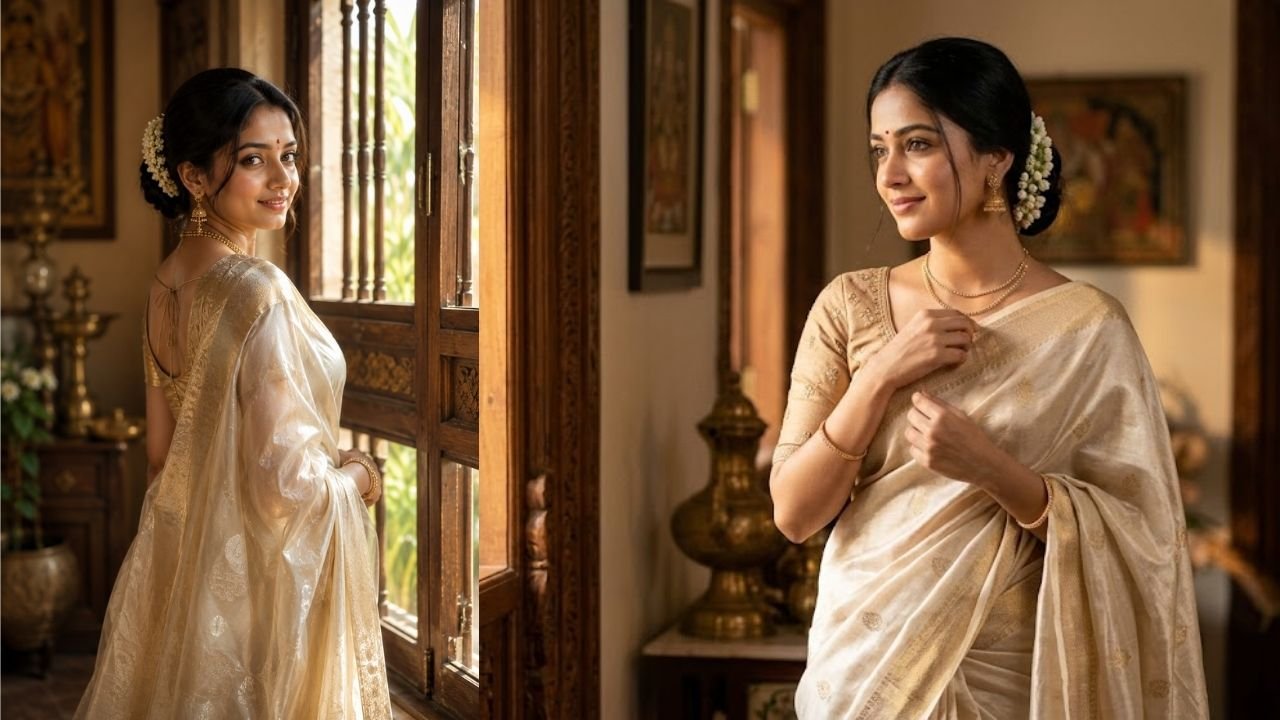
Drape the saree naturally in an elegant traditional Indian style, with carefully arranged pleats around the waist and the pallu falling gracefully over one shoulder and along her arm. The tissue silk should react naturally to the morning light, producing soft champagne-gold highlights along the folds and border without looking metallic or artificial. Pair the saree with a sophisticated warm beige-gold blouse featuring delicate traditional embroidery, fine threadwork, precise tailoring, an elegant neckline, and a classic back design. Keep the blouse refined and timeless so it complements the richness of the saree.
Adorn her with carefully selected traditional gold jewelry, including elegant handcrafted gold jhumka earrings, a delicate layered gold necklace, thin traditional gold bangles, and a few minimal rings. Add a tiny traditional red bindi centered naturally on her forehead. The jewelry should feature fine Indian craftsmanship, realistic antique-gold texture, intricate detailing, subtle metallic reflections, and believable proportions. Keep the jewelry sophisticated and balanced rather than excessively heavy.
Her long, naturally black hair should be arranged into a neat and graceful low bun at the back of her head. Decorate the bun with a small cluster of fresh white jasmine flowers arranged naturally around one side. Leave a few fine strands of hair softly framing her forehead, temples, and cheeks to make the hairstyle feel natural rather than perfectly styled. Show individual hair strands, realistic texture, natural volume, subtle flyaway hairs, and fine details in the jasmine petals.
Her face should have naturally beautiful Indian facial features with authentic facial proportions, expressive dark brown eyes, naturally shaped eyebrows, detailed eyelashes, a softly defined nose, naturally shaped lips, and a realistic warm Indian complexion. Preserve visible natural skin pores, fine facial lines, subtle texture variations, gentle under-eye details, natural highlights, and minor skin imperfections. Avoid porcelain-like or excessively smooth skin.
Use soft and elegant natural makeup that enhances her features without changing her realistic appearance. Add subtle eyeliner, softly defined eyelashes, warm neutral eyeshadow, lightly shaped eyebrows, a gentle natural blush, and soft nude-rose lips. Keep the makeup refined and understated. Her face should look like a real person photographed under flattering natural light rather than a digitally perfected beauty image.
Position her sideways beside a beautifully carved traditional wooden window inside a heritage-style Indian room. Her body should face slightly toward the window while her shoulders remain relaxed. She gently turns her head back over her shoulder toward the camera, creating a graceful three-quarter profile. Her expression should feature a soft, peaceful, warm smile with a calm and naturally confident gaze. Avoid an exaggerated fashion pose or artificial smile.
One hand should gently hold the tissue-silk pallu near her arm or waist, allowing the fabric to cascade naturally downward in soft folds. Her other hand should remain relaxed and naturally positioned. Make sure her hands and fingers are anatomically correct, realistically proportioned, and naturally interacting with the fabric. The posture should appear effortless, feminine, graceful, and believable.
The large traditional wooden window should feature intricate hand-carved Indian patterns, decorative latticework, naturally aged wood, visible wood grain, handcrafted panels, and warm brown tones. Include subtle greenery visible outside the window, softly illuminated by the morning sunlight. The carved wooden frame should add a heritage character to the composition without distracting attention from the woman.
Create a sophisticated heritage-style Indian interior in the background with carved wooden furniture, antique brass lamps, small brass decorative objects, subtle traditional Indian artwork, warm neutral walls, handcrafted décor, and understated cultural elements. Keep the room elegant and authentic rather than excessively luxurious. Allow these background details to gradually dissolve into a soft, creamy cinematic bokeh.
Use beautiful soft morning sunlight entering naturally through the wooden window from one side. The warm light should gently illuminate one side of her face, creating a delicate golden highlight along her cheekbone, nose, hair, shoulder, and saree. Allow the light to interact naturally with the tissue silk, producing subtle champagne-gold reflections across the folds and antique-gold border. The opposite side of her face should have soft, realistic shadows that create depth while preserving facial details.
Create subtle rim lighting around selected strands of her hair and the edge of her shoulder while maintaining natural exposure. The gold jewelry should catch tiny realistic highlights, and the jasmine flowers should remain softly illuminated without appearing unnaturally bright. Use gentle light falloff, balanced highlights, realistic shadow transitions, natural atmospheric depth, and a warm but controlled color temperature. Avoid excessive golden glow, blown highlights, artificial sun rays, or strong HDR effects.
The overall atmosphere should feel peaceful, timeless, feminine, sophisticated, warm, and luxurious. The ivory-cream saree, champagne-gold accents, warm wooden architecture, antique brass décor, white jasmine flowers, and gentle morning sunlight should create a harmonious premium Indian aesthetic. The final image should resemble a professionally photographed Indian fashion editorial inside an authentic heritage residence rather than an AI-generated scene.
Maintain completely realistic body proportions, natural shoulder and neck positioning, authentic saree draping, believable tissue-silk physics, anatomically accurate hands and fingers, realistic jewelry placement, individual hair strands, natural facial symmetry, genuine skin texture, and physically believable lighting throughout the composition.
Capture the portrait using a professional full-frame DSLR or mirrorless camera with a 50mm prime portrait lens at approximately f/1.8 aperture. Use a medium portrait composition, approximately waist-up, with her eyes, face, jasmine flowers, jewelry, blouse details, saree border, and tissue-silk texture rendered in crisp natural detail. Keep the subject sharply focused while allowing the wooden furniture, brass décor, traditional artwork, and deeper room elements to transition smoothly into realistic creamy bokeh.
Professional Indian fashion editorial photography, heritage Indian portrait aesthetic, premium saree photography, soft morning window light, cinematic yet natural lighting, realistic shadows, subtle champagne-gold highlights, authentic Indian skin tones, refined warm color grading, shallow depth of field, realistic optical bokeh, high dynamic range, detailed tissue-silk fibers, intricate zari craftsmanship, realistic skin pores, individual eyelashes and hair strands, ultra-detailed, ultra HD, 8K quality, extremely photorealistic.
Negative Prompt
Peach Chiffon Saree Portrait Image
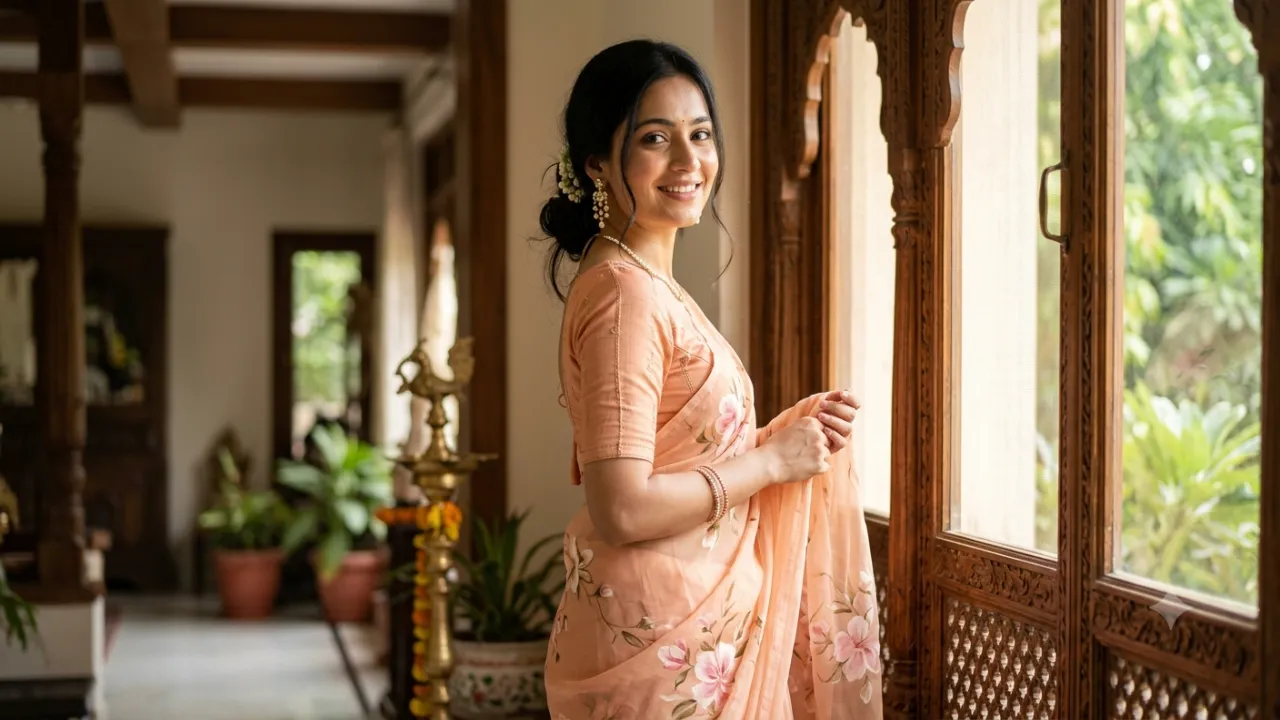
Drape the chiffon saree naturally in an elegant traditional Indian style, with neatly arranged pleats and a flowing pallu falling gracefully over one shoulder. The pallu should appear lightweight and slightly floating due to a very gentle morning breeze, while remaining physically realistic. One hand should hold the flowing pallu gracefully near her waist, allowing the floral patterns and delicate chiffon texture to remain clearly visible. Pair the saree with a sophisticated matching peach blouse featuring fine embroidery, delicate threadwork, a refined neckline, neat stitching, and a simple timeless design.
Adorn her with elegant pearl-and-gold jewelry, including delicate pearl drop earrings with subtle gold detailing, a fine pearl necklace, minimal gold bangles, and a few understated rings. The jewelry should look refined, feminine, and naturally proportioned. Show realistic pearl surfaces with soft natural luster and detailed gold craftsmanship with subtle reflections. Add a small natural-looking bindi that complements the peach and ivory color palette.
Her long, dark black hair should be styled into a loose, graceful low bun with a few soft strands naturally framing her forehead, temples, and cheeks. Tuck a few tiny fresh white flowers subtly into the hairstyle. Show individual hair strands, realistic texture, natural volume, delicate flyaway hairs, and believable placement of the flowers. The hairstyle should look elegant but naturally imperfect rather than overly polished.
Her face should have naturally beautiful Indian facial features with authentic proportions, expressive dark brown eyes, naturally shaped eyebrows, detailed eyelashes, a softly defined nose, naturally shaped lips, and a realistic Indian complexion. Preserve visible natural skin pores, subtle facial lines, fine skin texture, natural highlights, and minor imperfections. Her makeup should be soft and understated, featuring subtle eyeliner, naturally defined brows, warm neutral eyeshadow, a gentle peach-toned blush, and soft peach-pink lips. Avoid excessive makeup, heavy contouring, artificial skin smoothing, or a plastic beauty-filter appearance.
She is standing sideways beside a beautifully carved traditional wooden window inside an elegant Indian home. Her body is positioned slightly away from the camera, creating a natural three-quarter profile, while her head turns gently back over her shoulder toward the camera. She looks directly at the camera with a warm, gentle, charming smile and a relaxed expression. Her gaze should feel natural and confident without appearing overly posed.
Her posture should be graceful and relaxed, with natural shoulder positioning and realistic body proportions. One hand gently holds the flowing chiffon pallu near her waist while the other hand rests naturally by her side. Ensure both hands and all fingers are anatomically correct, naturally separated, and realistically positioned. Avoid exaggerated fashion poses, unnatural body twisting, or stiff posture.
The traditional wooden window should feature intricate Indian-inspired carving, decorative panels, subtle latticework, handcrafted patterns, visible natural wood grain, warm brown tones, and slight signs of age. Soft greenery should be visible outside the window, including blurred leaves, plants, and hints of a peaceful garden. Allow the morning sunlight to enter naturally through the window and interact with the wooden details and the flowing chiffon fabric.
Set the scene inside an elegant traditional Indian home featuring warm wooden textures, handcrafted furniture, subtle floral decorations, antique brass décor, traditional artwork, muted cream-colored walls, and tasteful cultural elements. Add a few small fresh flowers and understated decorative objects to create a warm and welcoming atmosphere. Keep the background visually balanced and uncluttered while maintaining enough detail to make the environment believable.
Use soft early-morning sunlight entering through the wooden window from one side. The sunlight should gently illuminate her face, cheek, shoulder, hair, pearl jewelry, and peach chiffon saree. Create a warm luminous glow along her cheekbone and hair while preserving realistic skin tones. Allow the light to pass softly through portions of the chiffon pallu, revealing its delicate transparency and floral artwork in a natural way.
Create realistic highlights along the pearl jewelry, subtle reflections on the gold elements, and delicate illumination across the floral patterns of the saree. Use soft shadows on the opposite side of her face, realistic light falloff, balanced exposure, gentle atmospheric depth, and natural shadow transitions. Avoid excessive glow, artificial sun rays, overexposure, or overly warm orange lighting.
The overall mood should feel feminine, peaceful, romantic, graceful, warm, and sophisticated. The combination of peach chiffon, soft floral patterns, pearl jewelry, white flowers, carved wood, and morning sunlight should create a delicate premium Indian fashion aesthetic. The final photograph should look like a genuine professional Indian fashion editorial captured inside a heritage-style home rather than an AI-generated image.
Maintain natural body proportions, authentic saree draping, physically believable chiffon movement, realistic transparency, anatomically correct hands and fingers, natural facial symmetry, realistic skin texture, believable jewelry placement, detailed floral patterns, individual hair strands, and consistent lighting throughout the scene.
Capture the photograph using a professional full-frame DSLR or mirrorless camera with a 50mm prime lens at approximately f/1.8 aperture. Use a medium portrait composition, approximately waist-up, with the woman's face, eyes, eyelashes, jewelry, hair, blouse, and saree details in sharp focus. Create a smooth creamy natural bokeh in the wooden window, brass décor, floral decorations, and greenery while keeping the environment recognizable.
Professional Indian fashion photography, elegant saree portrait, soft morning window light, romantic lifestyle photography, refined editorial aesthetic, natural Indian beauty, delicate pastel color palette, realistic chiffon texture, detailed hand-painted floral patterns, pearl and gold jewelry, cinematic composition, realistic shadows, shallow depth of field, creamy optical bokeh, high dynamic range, natural color grading, ultra HD, 8K, extremely detailed, sharp focus, photorealistic photographic quality.